
BlogsBlogs

Explore cutting-edge articles on laboratory products, industry innovations, and research trends with Lab Consulting.

Explore cutting-edge articles on laboratory products, industry innovations, and research trends with Lab Consulting.

How to Choose Laboratory Cabinets in 2026?

Choosing laboratory cabinets in 2026 requires more than comparing prices, finishes, and storage capacity. A cabinet may look impressive under showroom lighting, yet fail beside a corrosive bottle, a vibrating centrifuge, or a crowded workbench. The right decision begins with the laboratory’s actual risks, workflow, ventilation design, and maintenance habits. Those details matter.

James A. Kaufman, founder of the Laboratory Safety Institute, famously said, “Safety is not expensive, it’s priceless.” That principle still deserves attention. Laboratory cabinets should match the chemicals, instruments, temperatures, and cleaning methods used every day. Corrosive chemicals may require specialized materials. Flammable storage demands suitable construction and clear separation. Heavy equipment needs reinforced support, not optimistic measurements. Adjustable shelves can improve flexibility, but they can also become unstable when overloaded.

This guide examines how to evaluate laboratory cabinets for modern laboratories, including material selection, ventilation, fire resistance, ergonomics, accessibility, and long-term durability. It also considers sustainability and smart laboratory planning, because replacement costs often hide behind low purchase prices. A cabinet that survives ten years may be wiser than one that looks cheaper today. Still, no single cabinet suits every facility. That is the uncomfortable part. Even well-designed storage can fail when users ignore labels, exceed load limits, or block ventilation. Careful selection helps, but disciplined use completes the safety system.
How to Choose Laboratory Cabinets in 2026?

Laboratory Cabinet Types and Their 2026 Applications

How to Choose Laboratory Cabinets in 2026?

Laboratory Cabinet Types and Their 2026 Applications

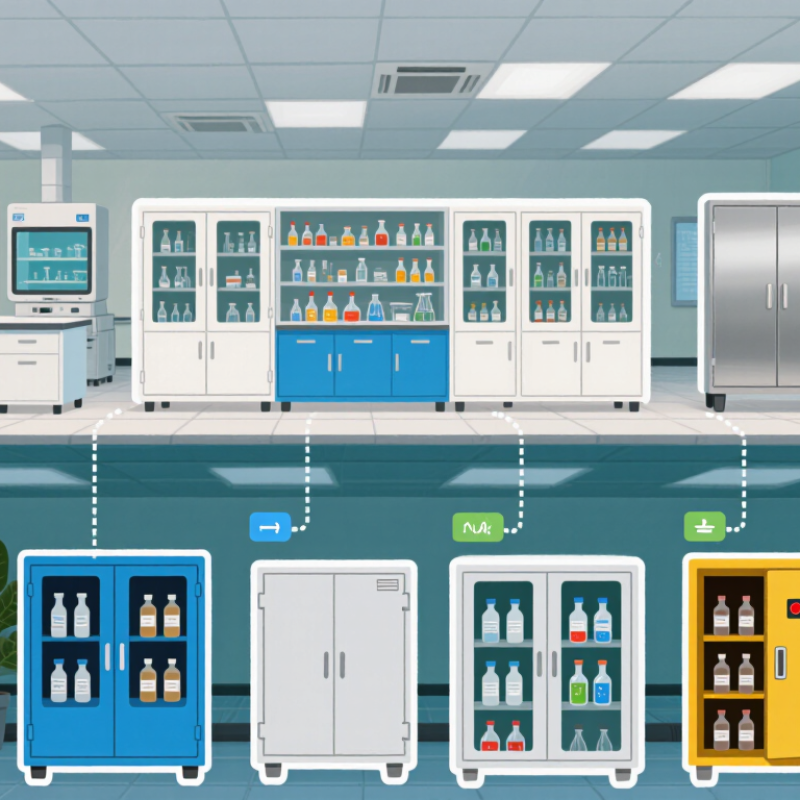
Laboratory cabinets now support more than simple storage. Base cabinets suit daily bench work, while wall cabinets keep lightweight glassware within reach. Mobile cabinets help flexible teaching laboratories adapt quickly. For corrosive materials, choose cabinets with chemically resistant interiors, sealed edges, and adjustable shelves. Flammable-storage cabinets need tested construction, secure doors, and clear capacity limits. Never treat ordinary furniture as chemical storage.

Ventilated cabinets are useful near analytical instruments, sample preparation areas, and laboratories handling irritating vapors. However, ventilation must match the room’s airflow plan. Poor placement can pull contaminants across a workspace. Biological laboratories may need smooth, cleanable cabinets beneath workstations. Powder-coated steel is practical in many rooms, but harsh chemicals can damage it over time. Stainless steel offers durability, although its cost and cleaning requirements deserve attention. A cabinet can look perfect on paper and still fail when doors block an emergency route.

Tips: Map cabinet use before selecting dimensions. Check shelf loads, door clearance, corrosion resistance, and cleaning access. Ask whether future equipment will need power, ventilation, or cable routing. Confirm local fire, building, and occupational-safety requirements with qualified professionals. Small oversights matter. I would also leave modest spare capacity. Laboratories change faster than expected.

How to Match Cabinet Materials with Laboratory Hazards

How to Choose Laboratory Cabinets in 2026?

Cabinet materials should match the hazards, not merely the laboratory’s visual style. Begin with the chemical inventory, safety data sheets, and exposure conditions. Acids and alkalis can damage ordinary painted steel, especially around leaking containers. High-pressure laminate or chemical-resistant resin may offer better protection for corrosive storage. Polypropylene works well with many aggressive chemicals, but it is not suitable for every solvent or heat source.

Flammable liquids need purpose-built storage with suitable fire resistance and grounding provisions. Solvent vapors can attack plastics, seals, and surface coatings over time. Stainless steel may resist moisture, yet it can still suffer from certain chemicals. In my experience, cabinet failures often begin at hinges, edges, or spill trays. These small areas deserve careful inspection. A clean surface can be misleading.

Tips: Compare the cabinet material with each chemical’s compatibility data. Check load capacity, ventilation needs, adjustable shelving, and spill containment. Ask for tested performance evidence, not vague claims. Keep incompatible substances separated, even inside the same cabinet. Review the selection with a qualified safety professional and your local requirements. One judgment may still be wrong. Recheck the choice after actual laboratory use.

How to Choose Laboratory Cabinets in 2026? - How to Match Cabinet Materials with Laboratory Hazards

Laboratory Hazard or Use Recommended Cabinet Material Typical Compatibility Key Advantages Important Limitations Recommended Design Features
General laboratory supplies, glassware and dry equipment Epoxy powder-coated steel Low-humidity areas and non-corrosive materials Strong, economical, easy to clean and widely available Coating can be damaged by strong acids, alkalis, solvents, chips or prolonged moisture Sealed edges, corrosion-resistant fasteners and replaceable shelf liners
Routine wet chemistry and moderate chemical exposure Type 304 stainless steel Many aqueous solutions, cleaning agents and general laboratory environments Durable, non-porous, hygienic and resistant to routine moisture Less resistant to chloride-rich solutions, hydrochloric acid and some concentrated chemicals Continuous welded seams, sloped spill shelves and prompt spill removal
Chloride-containing chemicals, saline environments and aggressive wet corrosion Type 316 stainless steel Improved resistance to chlorides and many marine or saline conditions Molybdenum-bearing alloy provides better pitting and crevice-corrosion resistance than Type 304 Not universally resistant to concentrated acids, halogens or elevated-temperature chemicals Avoid crevices, use compatible weld finishes and verify chemical concentration and temperature
Strong acids, strong alkalis and corrosive liquid storage Polypropylene Many mineral acids, alkalis and aqueous corrosive solutions at ambient temperature High resistance to many corrosive chemicals; does not rust Lower structural stiffness and temperature resistance than metal; compatibility varies by chemical Fully welded spill containment, corrosion-resistant hinges and mechanically supported shelves
Acid and alkali bottles requiring impact-resistant secondary containment High-density polyethylene (HDPE) Many aqueous acids, alkalis and salts; commonly used for chemical containers and liners Good chemical resistance, low moisture absorption and good impact resistance May soften or degrade with some oxidizers, aromatic solvents and high temperatures Use compatible trays, load-rated shelves and a chemical-specific compatibility review
Organic solvents such as alcohols, ketones and hydrocarbons Certified flammable-liquid cabinet with steel construction Flammable and combustible liquids when the cabinet is designed and certified for that purpose Provides organized storage, spill containment and fire-resistance performance when properly certified Ordinary cabinets are not an adequate substitute; internal plastic components may be solvent-sensitive Self-closing doors, raised liquid-tight sill, grounding provisions where required and no unauthorized ventilation modifications
Oxidizing agents, peroxides and strong oxidizing chemicals Dedicated corrosion-resistant cabinet selected for the specific oxidizer Chemical-dependent; compatible plastics or coated metal may be appropriate after verification Allows segregation from fuels, solvents, reducing agents and combustible materials Some oxidizers attack metals, plastics or coatings; contamination can create fire or explosion hazards Separate cabinet, non-combustible or verified-compatible shelving, clean spill trays and clear hazard labels
Highly corrosive fumes or volatile corrosive liquids Polypropylene or a purpose-built ventilated corrosives cabinet Fuming acids and volatile corrosives, subject to local ventilation and compatibility requirements Reduces corrosion of surrounding equipment and can limit vapor accumulation when correctly ventilated Ventilation does not make incompatible chemical storage safe; some fumes require dedicated exhaust treatment Connect only to an engineered exhaust system, provide secondary containment and segregate acids from bases
Cleanrooms, microbiology and contamination-sensitive work Stainless steel with smooth, sealed surfaces Routine disinfectants, wash-down areas and controlled environments Non-porous surface supports cleaning and reduces locations where contaminants can collect Some disinfectants containing chlorides can stain or pit stainless steel if residues remain Rounded corners, minimal seams, adjustable sealed feet and compatibility with the cleaning protocol
Radioactive materials or radioactive sources Material selected by radiation type and required shielding Steel provides structural support; lead or other shielding materials may be required for specific radiation energies Can be configured for shielding, access control and contamination containment Cabinet material alone does not determine shielding performance; shielding calculations are site-specific Lockable access, secure source holders, wipe-clean surfaces and review by a radiation-safety professional
Selection note: Chemical compatibility depends on concentration, temperature, exposure time, vapor conditions and the complete cabinet construction, including fasteners, hinges, seals, coatings and shelf liners. Always check current safety data sheets and applicable local fire, chemical-storage and occupational-safety requirements. Material compatibility does not replace certified fire protection, ventilation design or chemical segregation.

Key Safety, Compliance, and Ventilation Requirements

How to Choose Laboratory Cabinets in 2026?

Key Safety, Compliance, and Ventilation Requirements

A laboratory cabinet should match the hazard, not only the room’s appearance. Start with chemical compatibility, load capacity, corrosion resistance, and fire performance. A cabinet storing acids needs different materials from one holding solvents or biological samples. Check hinges, seals, shelves, and spill-retention trays. Small failures matter.

Ventilation requires careful judgment. A fume cabinet should capture vapors at a verified face velocity, with airflow tested after installation and maintenance. Ducts must suit the chemicals, and exhaust should discharge safely away from air intakes. Do not assume every storage cabinet needs connection to the building system. Some require controlled ventilation, while others need sealed storage and clear hazard labeling. Recirculating filtration may be unsuitable for unknown, highly toxic, or reactive vapors. Get advice from a qualified ventilation engineer.

Compliance documents should identify tested performance, materials, maximum loads, inspection intervals, and emergency procedures. Confirm requirements with local building, fire, occupational safety, and environmental authorities.

In practical assessments, a cabinet can pass a visual inspection yet fail because its door does not close fully or its airflow alarm is ignored. Keep access paths clear. Train users to segregate incompatible chemicals and report damaged trays immediately. A perfect specification can still fail through poor housekeeping. That is worth reconsidering.

Evaluating Storage Capacity, Ergonomics, and Workflow

Choosing laboratory cabinets in 2026 should begin with workflow, not catalog dimensions. In practice, I map each task from delivery to disposal, then mark every reach, turn, and pause. Storage capacity means usable volume, not advertised cubic footage. Measure shelves, drawer clearances, container heights, and future equipment. Keep frequently used glassware between knee and shoulder height. Reserve lower cabinets for heavier, less frequent items. Shorter paths matter. A 2024 BLS report recorded 2.6 million nonfatal workplace injuries and illnesses in private industry. It does not isolate laboratories, but it reinforces a practical point: small physical demands accumulate.

Ergonomics should be tested with real users and real loads. Check handle force, door swing, seated access, and pinch points. Adjustable shelves can prevent awkward stacking. Pull-out trays may improve visibility, though they consume clearance. NIOSH’s Elements of Ergonomics Programs recommends identifying risk factors, involving workers, and evaluating controls after installation. That sequence is useful, not glamorous. Watch a technician retrieve a bottle while wearing gloves. The “best” cabinet can fail here. My first layouts often ignored open-door interference. That mistake is easy to repeat.

Workflow planning should connect cabinets with benches, sinks, waste points, and emergency routes. The 2022 ILO report estimated 1.9 million deaths annually from work-related factors worldwide. Cabinet choices cannot solve that scale, but disciplined design can reduce avoidable strain and obstruction. Use a simple heat map: red for daily access, amber for weekly access, and gray for reserve stock. Validate it during a normal shift, not a showroom walk-through. Leave a modest capacity buffer. Too much storage encourages forgotten inventory. Too little creates clutter. Neither outcome is elegant.

Comparing Smart Features, Sustainability, Costs, and Maintenance

How to Choose Laboratory Cabinets in 2026?

Comparing Smart Features, Sustainability, Costs, and Maintenance

Smart laboratory cabinets should improve safety, not merely display digital controls. Look for airflow sensors, temperature alerts, door-status notifications, and clear error indicators. Remote alerts can help supervisors respond before storage conditions become unsafe. However, connectivity adds software updates, cybersecurity duties, and possible repair costs. A cabinet with fewer, dependable functions may outperform an impressive but poorly supported system. Ask for sensor accuracy, data-retention policies, and replacement procedures before purchasing.

Sustainability requires more than recycled materials. Examine the cabinet’s service life, energy demand, repairability, and disposal options. Modular shelves, replaceable seals, and durable coatings can reduce waste over many years. Low-emission materials also support cleaner indoor air. Request environmental documentation rather than relying on broad marketing claims. Some products look sustainable but contain difficult-to-replace components. That deserves careful questioning.

Price comparisons should include installation, calibration, filters, inspections, electricity, and staff time. A cheaper cabinet may become expensive when parts require specialist service. Check whether maintenance access is practical while wearing gloves and protective clothing. Hinges should move smoothly, seals should remain flexible, and alarms should be tested on a documented schedule. No cabinet is maintenance-free. In real laboratories, neglected small faults often become larger interruptions. I would choose reliable service support over unnecessary features, even when the initial quotation is higher.

Newsletter

Subscribe to our newsletter and receive the latest news and exclusive insights every month. No spam.