



Class II Biological Safety Cabinets: Mars vs. Mars Pro
- December 23, 2025
- Last Updated: December 23, 2025
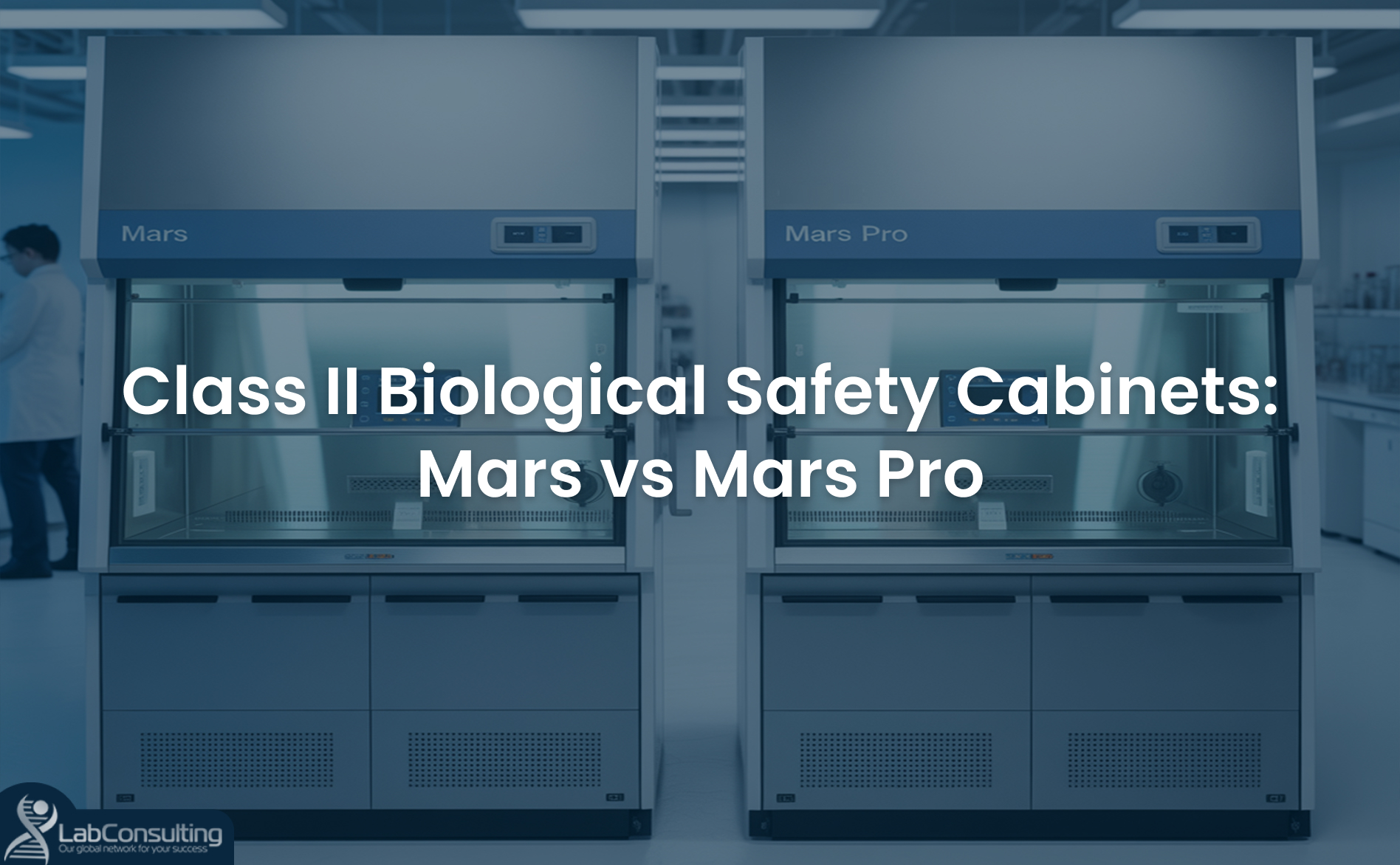
If you’re new to biosafety cabinets, here’s the simple truth: a Class II biological safety cabinet (BSC) is a clean-air workspace that protects you, your samples, and the room at the same time.
It does this by pulling air into the cabinet to protect the operator, pushing clean, filtered air down over your work to protect the product, and sending filtered exhaust back out to protect the environment.
In this guide, we compare two well-known Class II options: Mars and Mars Pro in an easy, step-by-step manner so lab managers, technicians, and students can choose with confidence.
- Mars (Class II, dual-filter): Excellent for everyday microbiology and cell culture where standard Class II protection is enough.
- Mars Pro (Class II, triple-filter): Built for higher-risk tasks (e.g., cytostatics, virus manipulation, Cat. 3 work per SOPs), adding extra filtration for more safety.Both are EN 12469 compliant, energy-efficient, and designed for comfort during long sessions. The key difference is how many HEPA filters the downflow air passes through (one in Mars vs. two in Mars Pro), plus a HEPA on exhaust in both, giving Mars Pro triple-filter protection.
Why this comparison matters?
- Safety fit: Pick a cabinet that matches your risk level and SOPs.
- Workflow fit: Choose the right size (900/1200/1500/1800 mm) for your equipment and team.
- Cost of ownership: Balance energy, noise, and maintenance with the level of protection you actually need.
If you’re deciding for a new lab or upgrade, follow along by the end, you’ll know whether Mars or Mars Pro is the better fit for your applications and safety requirements.
What Is a Class II Cabinet?
A Class II biological safety cabinet (BSC) is a clean-air workstation that gives three-way protection at the same time:
- Operator protection: Room air is pulled into the front opening, so aerosols move away from your face.
- Product protection: Clean, filtered air blows down over your work to keep samples free from dust and microbes.
- Environmental protection: Air leaving the cabinet is HEPA-filtered before it returns to the room (or duct).
In short: air in to protect you, clean air down to protect samples, filtered air out to protect the lab. That “triple protection” is what defines Class II.
Where Class II is used
- Cell and tissue culture
- General microbiology and sterile prep
- Viral work (as allowed by your SOPs and facility approvals)
- Pharmacy compounding (where relevant standards allow)
- Sampling and routine research that needs a clean zone
Note: Class II BSCs are not fume hoods. They’re not meant for toxic, volatile chemicals unless your setup and approvals explicitly allow it. Always follow your biosafety officer’s guidance.
How Class II Airflow Works
Inside a Class II cabinet, air moves in a smooth, vertical pattern (laminar downflow) and follows a simple 70/30 split:
- About 70% of air is recirculated through HEPA filters and blown downward over the work surface (keeps samples clean).
- About 30% is exhausted through a HEPA filter (protects the room).
Room air → front opening (operator protection)
↓ under worktop → up rear plenum
├─ 70% → HEPA(s) → clean DOWNFLOW over work (product protection)
└─ 30% → HEPA → clean EXHAUST (environment protection)
Mars vs. Mars Pro in this airflow
- Mars (dual-filter): One HEPA for the downflow + one HEPA for the exhaust.
- Mars Pro (triple-filter): Two HEPAs clean the downflow air (extra layer against cross-contamination) + one HEPA for exhaust.
Both use the same 70/30 airflow principle. Mars Pro simply adds redundancy on the clean-downflow path, which is why labs choose it for higher-risk tasks (per SOPs).
Why laminar downflow matters
- Even, top-to-bottom air sweeps particles away from your critical work.
- Fewer swirls/turbulence means fewer contaminants settling on plates, flasks, or open vessels.
- Consistent sterility zone—as long as you don’t block the front or rear grilles and you move your arms slowly.
Soft checkpoint
You now know what a Class II cabinet is and how the 70/30 airflow protects you, your samples, and the room. Next, we’ll go deeper into Mars vs. Mars Pro differences—filters, use cases, and how to choose the right one for your risk level and workflow.
Mars vs. Mars Pro: Key Differences
Let’s put the two Class II biological safety cabinets side by side in a simple way. Both protect the operator, product, and environment using the same 70/30 airflow principle and meet EN 12469. The main difference is how the downflow air is filtered and that affects risk level, redundancy, and typical use cases.
Key differences at a glance:
| Feature | Mars (Class II) | Mars Pro (Class II) |
|---|---|---|
| Downflow filtration | Single HEPA on supply | Double HEPA on supply (two in series) |
| Exhaust filtration | HEPA | HEPA |
| Air split | ~70% recirculated downflow / ~30% HEPA exhaust | Same 70/30 split |
| Protection level | Class II standard protection | Class II with extra redundancy |
| Best fit | Routine microbiology, tissue culture, IVF, sampling (per SOPs) | Higher-risk work: cytostatics, virus manipulation, Category 3 organisms (per facility approvals/SOPs) |
| Cross-contamination risk | Low | Very low (double-filtered downflow) |
| Energy, heat, noise | Energy-efficient fans; low heat/noise | Same design focus; optimized for low heat/noise |
| Maintenance | Standard filter changes | More filters to monitor and replace (two downflow HEPAs) |
| Sizes (working width) | 900 / 1200 / 1500 / 1800 mm | 900 / 1200 / 1500 / 1800 mm |
| Compliance | EN 12469 | EN 12469 |
What actually changes in the Mars Pro
- Double-HEPA downflow: Mars Pro adds a second HEPA on the supply path before air reaches your work. This reduces cross-contamination risk and provides redundancy if one filter begins to load.
- Application scope: Because of that redundancy, labs often select Mars Pro for hazardous or more sensitive tasks (always subject to your biosafety officer’s assessment and local rules).
What stays the same in both
- Core Class II protections: Operator, product, and environment are protected via inflow, downflow, and HEPA exhaust.
- 70/30 airflow design: Around 70% of air is recirculated as clean, vertical laminar downflow; 30% is filtered exhaust.
- Ergonomics and efficiency: Angled viewing, comfortable arm position, energy-efficient fans, low noise, and lower heat to keep the workspace comfortable.
How to decide (quick logic)
- Choose Mars if your work is standard BSL-2 (e.g., routine cell culture, non-high-risk microbiology) and your SOPs don’t require extra filtration layers.
- Choose Mars Pro if your lab handles higher-risk materials (e.g., cytostatics, virus work, Cat. 3 pathogens) and your SOPs or risk assessment call for redundant downflow filtration.
Tip: If you’re equipping a mixed-use lab, match the cabinet to the highest-risk workflow you’ll actually perform. Overspecifying raises maintenance costs; underspecifying raises safety risk. Align with your biosafety officer and facility approvals first, then optimize for size, layout, and total cost of ownership.
When Should You Choose Mars Pro?
If your work involves higher risk or your SOPs require extra redundancy, choose Mars Pro. It adds a second HEPA on the downflow, lowering cross-contamination risk while keeping the same Class II protections and 70/30 airflow.
Quick rule of thumb
- Choose Mars Pro when any of the following are true.
- If none apply, Mars is usually sufficient (per your risk assessment).
Scenarios that point to Mars Pro
- Cytotoxic/cytostatic preparations (e.g., oncology compounding) where extra particulate control and redundant filtration are mandated.
- Virus manipulation (e.g., amplification, high-titer stocks) where minimizing cross-contamination is critical.
- Category 3 pathogens workflows (as approved by your facility and biosafety officer).
- Mixed-risk spaces where the cabinet may be used for both routine and higher-risk tasks, and you want one model to safely cover the peak risk.
- Audit or accreditation needs where reviewers expect redundant downflow filtration for specific procedures.
- Sensitive product work (e.g., IVF, cell therapy steps) where an extra barrier reduces the chance any loaded filter could compromise the work before service.
Note: A Class II BSC is not a fume hood. If you use volatile/toxic chemicals, you may need a ducted solution and specific approvals. Always confirm with your biosafety officer and local regulations.
Facility & SOP considerations
- Exhaust strategy: Decide recirculating vs. ducted (thimble/hard-duct) per SOPs; higher risk → ducted.
- Room controls: Verify pressurization, ACH, and clearances; keep front/rear grilles unblocked.
- Validation & service: Plan IQ/OQ, EN 12469 airflow/containment tests, and regular re-certification.
- Decontamination: SOP for routine wipe-downs and full decon (e.g., vapor) before filter changes or moves.
- Training: Teach slow arm movements, grille discipline, correct sash height, and clean→dirty workflow.
Cost-of-ownership lens
- Filters: Mars Pro has two downflow HEPAs—more safety, slightly higher maintenance.
- Uptime: Redundancy reduces unplanned downtime from a single filter issue.
- Comfort & efficiency: Energy-efficient fans lower power, heat, and noise, improving comfort and operating costs.
Decision checklist
- Required work includes cytostatics, virus work, or Cat 3? → Mars Pro
- SOPs or auditors demand redundant downflow filtration? → Mars Pro
- One cabinet must safely handle mixed-risk tasks? → Mars Pro
- Strict contamination control for sensitive products? → Mars Pro
- Otherwise, routine BSL-2 cell culture/microbiology? → Mars (standard Class II)
Not sure which way to go? Share your process list and SOP highlights, and We’ll map them to a clear Mars vs. Mars Pro recommendation with sizing and exhaust notes.
Energy, Heat & Noise: Why They Matter for Safety and Costs?
Both Mars and Mars Pro Class II biological safety cabinets are designed to be energy-efficient, cooler, and quieter. That’s not just comfort—it directly supports sample quality, operator performance, and total cost of ownership (TCO).
1) Energy use: what does it affect
- Operating cost: Efficient fans/airflow = lower electricity bills.
- Filter life: Smooth airflow protects HEPAs; blockages make the fan work harder and shorten filter life.
- Sustainability: Less power and fewer filter swaps = smaller footprint.
Practical tips
- Use standby/eco mode between runs.
- Keep front/rear grilles clear.
- Replace pre-filters on schedule.
2) Heat: why cooler is safer
- Sample stability: Extra heat can affect cells/reagents.
- Room control: Less waste heat helps HVAC keep steady temp/humidity.
- Operator comfort: Cooler cabinet = less fatigue.
Practical tips
- Don’t place warm devices (e.g., hot plates) in the airflow path.
- Make sure room supply vents aren’t aimed at the front opening.
3) Noise: more than a comfort issue
- Accuracy & fatigue: Lower noise improves focus and reduces errors/turbulence.
- Communication: Quieter cabinet = easier training/teamwork.
Practical tips
- Position away from doors/windows/high-traffic areas.
- If the lab is noisy, add acoustic panels or move loud gear away.
4) Why Mars/Mars Pro help here
- Efficient fans + optimized ducts = less power for the same certified airflow.
- Lower noise profile supports long, careful work.
- Reduced heat spill keeps the work zone and room more stable.
Daily Use Checklist (Before / During / After Work)
Use this simple, step-by-step routine to keep airflow stable, your samples clean, and operators safe. It applies to both Mars and Mars Pro.
Before you start (5–15 min)
- PPE: Lab coat, gloves, eye protection (per SOP).
- Checks: Sash at mark; alarms OK; front/rear grilles clear; no drafts toward the opening.
- Start & stabilize: Fan/light ON; run 10–15 min.
- Disinfect: Wipe top → sides → work surface → front grille (respect contact time).
- Set layout: Clean → active → waste; keep tall items to sides/back; center clear.
- Prep items: Unwrap outside; wipe in with 70% alcohol; bring only what you need.
- No flames: Use approved alternatives if needed.
While you work
- Position: Hands 10–15 cm inside; move slowly.
- Grilles: Don’t block or rest items on front/rear grilles.
- Technique: Keep lids angled down; cap before moving; smooth pipetting; low-aerosol tips.
- Gloves: Disinfect often; change if dirty/wet or after touching non-sterile items.
- Waste: Use small biohazard bin inside; don’t overfill; sharps → sharps container.
- Spills: Keep fan ON; cover, apply disinfectant from edges inward, wait contact time, clean per SOP, report.
When you’re done
- Secure: Close/seal plates, tubes, and waste inside the cabinet.
- Disinfect: Wipe back → sides → work surface → front grille; allow contact time.
- Purge: Run 5–10 min after cleaning; then OFF or standby.
- Sash & log: Lower/lock sash; record user/task/time and any alarms/pressures.
- UV (if fitted): Use only with sash closed and no one present; UV doesn’t replace surface disinfection.
FAQs:
1. What does a Class II biological safety cabinet protect (operator, product, environment)?
You, your samples, and the room via inflow, clean downflow, and HEPA-filtered exhaust.
2. How does the 70/30 airflow in a Class II biosafety cabinet work?
About 70% recirculates as clean downflow; 30% exits through a HEPA exhaust.
3. Is the Mars Pro Class II biosafety cabinet safer than the standard Mars?
Yes. It adds a second HEPA on the downflow (triple-filter path) for extra redundancy and lower cross-contamination risk.
4. Do I need ducted exhaust for a Class II biological safety cabinet, or can it be recirculating?
It depends on your SOPs and local rules. Many setups recirculate; higher-risk or chemical workflows may require ducted exhaust.
5. Can I use volatile or toxic chemicals inside a Class II biological safety cabinet (vs. a chemical fume hood)?
A Class II BSC is not a fume hood. Volatile/toxic chemicals need the approved ducted solution and specific approvals.
6. Is UV light required in a Class II biosafety cabinet for disinfection?
No. UV is optional and never replaces surface disinfection. Use only with sash closed and no one present, per SOP.
7. How often should HEPA filters be changed in a Class II biosafety cabinet (Mars / Mars Pro)?
Based on pressure/airflow readings, usage, and service plan. Mars Pro has two downflow HEPAs to monitor.
8. Which Class II biosafety cabinet size should I choose (900 mm, 1200 mm, 1500 mm, 1800 mm)?
Match your layout. 1200 mm fits most workflows; choose 1500/1800 mm if equipment would block grilles in smaller sizes.
9. Can two people work simultaneously in a Class II biosafety cabinet safely?
One user is best to avoid turbulence. If two must work, use strict SOPs and a wider unit, and re-validate performance.
10. What are typical noise levels for Class II biosafety cabinets and how can I reduce noise?
Both models use efficient fans for lower noise. Placement away from drafts/doors helps keep the operation quiet.
11. Is EN 12469 certification mandatory for Class II biological safety cabinets, and how often should they be re-certified?
Yes. Commission to EN 12469 at install and re-certify on schedule (typically annual or per SOP), and after moves/service.
12. What standards do Mars and Mars Pro Class II biosafety cabinets meet?
Both Mars and Mars Pro are manufactured and tested to EN 12469, the key performance standard for Class II BSCs in Europe.
13. How long should a Class II biosafety cabinet run before starting work and after cleaning (purge time)?
Run the cabinet 10–15 minutes before work to stabilize airflow; 5–10 minutes purge after cleaning.
Conclusion :
Choosing between Mars and Mars Pro comes down to risk level, workflow needs, and SOP requirements. Both are EN 12469 Class II cabinets that protect operator, product, and environment using the proven 70/30 airflow. The Pro model adds a second HEPA on the downflow (triple-filter path), giving extra redundancy for higher-risk tasks.
Want this guidance customized to your SOPs and bench layout?
Share your use cases and equipment list! We’ll map a final Mars vs. Mars Pro recommendation with size and exhaust notes you can hand to procurement.
About The Author
Contact Us
RECENT POSTS
-

- December 23, 2025
How Innovation Labs Are Shaping Austria’s Scientific Landscape
Innovation labs in Austria are transforming the scientific landscape. In the past five years, their number has doubled, boosting research...
Read More -

- December 23, 2025
Premier Laboratory Technical Services in Austria
Maintaining your equipment’s precision and efficiency is crucial in the rapid-fire environment of scientific research and laboratory operations. A famous...
Read More -

- December 23, 2025
Professional Laboratory Outsourcing Services for all Labs Operation in Austria
Running successful laboratory operations in Austria and Germany requires more than just advanced technology and skilled manpower. Efficient lab outsourcing...
Read More


