Explore cutting-edge articles on laboratory products, industry innovations, and research trends with Lab Consulting.
A laboratory equipment list is more than a catalogue of products. For global buyers, it is a practical starting point for comparing specifications, supplier capabilities, documentation, and after-sales support. China offers a broad range of laboratory products, from microscopes and centrifuges to incubators, balances, and water purification systems. The challenge is choosing equipment that fits the work—not simply choosing the lowest price.
Safety researcher James Reason wrote, “We cannot change the human condition, but we can change the conditions under which humans work.” His principle concerns safety systems, but it also applies to laboratory planning: suitable equipment, clear operating instructions, and thoughtful workspace design can help reduce avoidable mistakes. A checklist helps. It cannot replace technical review.
This guide introduces key categories for buyers assessing Chinese suppliers. It highlights details worth checking, such as measurement range, power requirements, calibration records, warranty terms, and available spare parts. Ask for specifications in writing. Compare like with like. A polished product page is not proof of performance, and a low price may leave important service questions unanswered. No list is perfect. Requirements differ by application, facility, and budget, so readers should verify each item against their own protocols and qualified technical advice before purchasing.
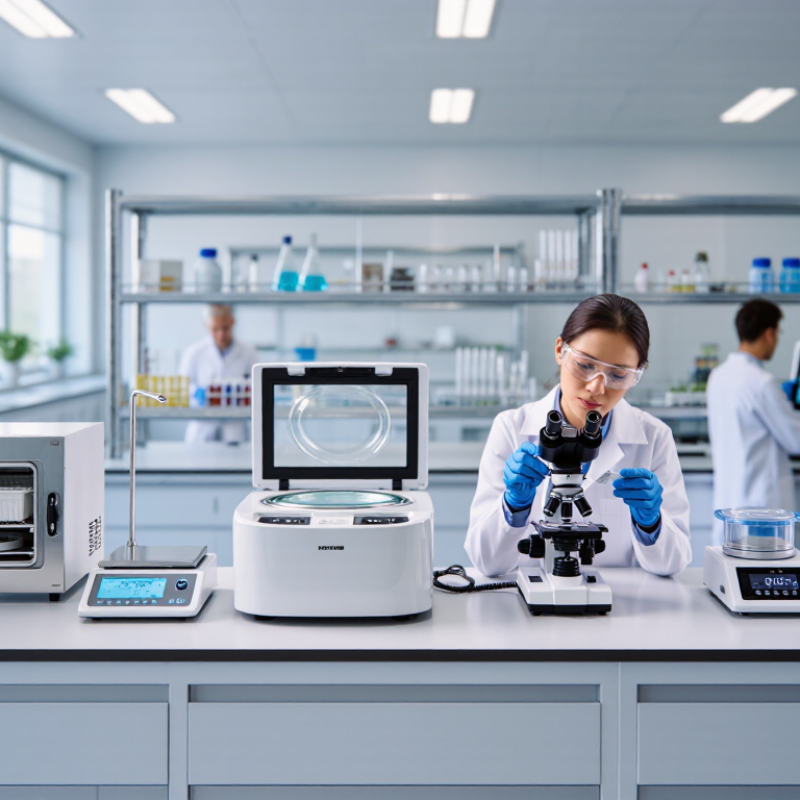
China’s laboratory equipment industry serves universities, hospitals, testing centers, and manufacturers. Its product range includes balances, centrifuges, drying ovens, water baths, microscopes, and sample-preparation tools. Many suppliers draw on domestic component networks, supporting flexible production and varied specifications. Fit varies. Buyers should assess each instrument on its own merits.
Details matter. A centrifuge’s rotor capacity, a balance’s readability, and an oven’s temperature uniformity can affect daily results. Ask for calibration records, operating manuals, maintenance guidance, and clear warranty terms. For temperature-controlled equipment, request stability and uniformity data under stated test conditions. A polished catalog is not enough. Check whether spare parts and technical support are available where the equipment will be used.
The industry is changing as laboratories seek digital monitoring, lower energy use, and easier routine maintenance. Yet added features do not replace validation. A connected instrument may still need careful setup and trained operators. Product quality can vary between models and production batches; this deserves honest attention. Buyers can compare specifications, review independent test evidence where available, and arrange a practical demonstration before larger orders. A small trial can reveal noise, workflow delays, or awkward controls that a specification sheet misses.
China’s rising research and development investment provides context for demand across research infrastructure, including laboratory equipment. These figures represent total national R&D expenditure, not laboratory equipment sales.
Source: National Bureau of Statistics of China. Annual national R&D expenditure; values are in trillion yuan.
Major categories of laboratory equipment made in China include analytical instruments, sample-preparation tools, life-science equipment, cold-storage units, and laboratory furniture. Analytical ranges include balances, pH meters, spectrophotometers, and chromatography systems. Sample preparation covers centrifuges, mixers, and drying ovens. Life-science labs commonly need incubators, water baths, and biosafety cabinets. Grand View Research estimated the global laboratory equipment market at USD 58.4 billion in 2023, projecting a 7.2% compound annual growth rate from 2024 to 2030. The report signals broad demand, but its global figures do not measure Chinese-made equipment alone.
For buyers, category matters less than fit. A centrifuge’s rotor capacity, a freezer’s temperature stability, and a cabinet’s airflow documentation affect daily work. Ask for calibration records, electrical specifications, spare-parts availability, and clear installation requirements. Check whether consumables fit the instrument, too. Small details matter. The category labels are useful, but not enough; product quality and documentation can vary between suppliers. I would treat catalogue descriptions as a starting point, then compare test reports and service terms against the lab’s actual workload. That takes longer. It can prevent an expensive mismatch.
For global buyers, equipment selection should start with the test method, sample volume, and expected workload. An analytical balance may need 0.1 mg readability for small-mass measurements, while routine weighing often calls for less sensitivity. Check capacity, repeatability, draft protection, and calibration options. Small details matter. A centrifuge should match tube size, rotor capacity, and required relative centrifugal force, not just its maximum speed. A microscope’s objective magnification, illumination, and camera compatibility shape its usefulness for inspection or teaching. In practice, the perfect specification rarely exists; a compromise may still need review.
Spectrophotometers support concentration checks and routine absorbance measurements. Buyers should compare wavelength range, bandwidth, cuvette compatibility, and baseline stability. Incubators are selected by temperature range, uniformity, and chamber capacity; these affect cell, microbial, and sample workflows. For sterilization, autoclave chamber size, temperature control, and cycle records are practical checkpoints. Ask for test data and service guidance, and confirm that stated performance fits your actual operating conditions. A long feature list is not proof of better results.
Tips: Measure benches and doorways before ordering. Keep spare capacity in mind, but avoid buying specifications your team will not use. Record acceptance checks at installation. Small oversights can delay routine work.
Typical specifications are provided for equipment selection; actual performance varies by model, configuration, accessories, and applicable standards.
| Equipment Type | Key Specifications | Typical Applications | Buyer Checks |
|---|---|---|---|
| Analytical Balance | Typical readability: 0.1 mg; capacity commonly 100–320 g; draft shield; internal or external calibration options. | Precise weighing of reagents, reference materials, and small samples. | Confirm readability, repeatability, calibration method, weighing pan size, and environmental requirements. |
| Benchtop Centrifuge | Rotor-dependent capacity; common maximum speeds are approximately 4,000–15,000 rpm. Relative centrifugal force (RCF) depends on rotor radius and speed. | Separating cells, precipitates, and other sample components by centrifugal force. | Check compatible rotors and tubes, maximum RCF, temperature control, imbalance detection, and lid safety interlock. |
| Micropipette | Adjustable-volume models are available in separate ranges, commonly covering about 0.1–1,000 µL across a pipette set; air-displacement and positive-displacement types are available. | Accurate transfer and dispensing of microliter-volume liquids. | Verify the required volume range, accuracy and precision, tip compatibility, calibration service, and sterilization limits. |
| pH Meter | Typical measurement range: pH 0–14; resolution often 0.01 pH; temperature compensation may be manual or automatic. | Measuring acidity or alkalinity in aqueous samples, buffers, and process solutions. | Check electrode type, calibration points, temperature probe, data logging, and availability of replacement electrodes. |
| UV-Visible Spectrophotometer | Common wavelength coverage: approximately 190–1,100 nm; supports absorbance and transmittance measurements; available in single- or double-beam designs. | Concentration measurement, spectral scans, and routine analysis of samples that absorb ultraviolet or visible light. | Confirm wavelength range and accuracy, bandwidth, cuvette path length, software, and relevant validation requirements. |
| High-Performance Liquid Chromatography (HPLC) System | Typical configuration includes a pump, injector or autosampler, column compartment, detector, and data system; pressure capability is system-dependent and may reach several hundred bar. | Separating, identifying, and quantifying components in pharmaceutical, food, environmental, and chemical samples. | Match detector and column chemistry to the method; check solvent compatibility, pressure rating, flow range, and local service support. |
| Laboratory Autoclave | Steam sterilization cycles commonly use 121°C or 134°C; chamber capacity and cycle programs vary. Cycle time depends on load, packaging, and validated process conditions. | Sterilizing suitable laboratory media, instruments, glassware, and biohazard waste. | Confirm chamber volume, loading format, utilities, pressure-vessel compliance, safety features, and cycle validation options. |
| CO₂ Incubator | Common settings include temperatures near 37°C and CO₂ control around 5%; humidity, sensor type, and recovery performance depend on design. | Culturing mammalian cells under controlled temperature, carbon dioxide, and humidity conditions. | Check chamber capacity, CO₂ sensor and control range, contamination-control features, alarm functions, and cleaning requirements. |
| Class II Type A2 Biosafety Cabinet | Provides personnel, product, and environmental protection for appropriate microbiological work using HEPA-filtered airflow; a typical A2 airflow design recirculates about 70% and exhausts about 30%. | Handling potentially infectious biological materials when the cabinet and work practices are appropriate to the risk assessment. | Verify applicable cabinet standard, certification, airflow alarms, exhaust configuration, installation needs, and scheduled testing. |
| Chemical Fume Hood | Ducted designs capture and exhaust chemical vapors; required face velocity and containment performance depend on the applicable standard and installation. | Reducing exposure to hazardous chemical vapors during suitable laboratory procedures. | Assess ducting, exhaust capacity, sash design, alarms, chemical compatibility, and commissioning tests at the installation site. |
| Laboratory Refrigerator | Typical refrigerated storage is maintained near 2–8°C; temperature range, uniformity, monitoring, and alarm features vary by unit. | Storing temperature-sensitive reagents, prepared media, and laboratory samples within their specified storage conditions. | Check temperature mapping, independent monitoring, alarms, usable capacity, door configuration, and backup-power plan. |
| Laboratory Water Purification System | Treatment may combine reverse osmosis, deionization, and polishing stages; Type I ultrapure water has a theoretical resistivity of 18.2 MΩ·cm at 25°C. | Preparing water for analytical methods, reagent preparation, instrument feed, or general laboratory use, depending on water grade. | Specify required water grade, feed-water quality, output rate, consumable replacement intervals, and monitoring parameters. |
Evaluating Chinese laboratory equipment manufacturers takes more than comparing prices and polished catalogs. Ask for technical drawings, material specifications, and calibration records for the exact model under consideration. Check whether the stated measurement range, accuracy, and operating conditions match your laboratory’s needs. Details matter.
Request a sample unit or arrange a live demonstration. Observe how doors, controls, and fittings feel during normal use, then test performance against your own acceptance criteria. Ask how the manufacturer handles installation, spare parts, repairs, and response times across your region. Ask for evidence. Verify certificates with the issuing body where possible, and confirm that the documents apply to the product and production site being quoted.
A factory visit or independent inspection can reveal practical details, such as assembly checks and packaging methods. Compare lead times and payment terms, but treat unusually low quotes as a reason to investigate, not proof of poor quality. Written answers help you compare suppliers fairly. Still, no checklist removes every risk; production changes and shipping delays can occur. I would also avoid judging a supplier from one successful video call. A clear contract, agreed inspection points, and documented acceptance criteria make expectations easier to manage.
For global buyers, laboratory equipment must meet the requirements of its destination market, not just the supplier’s home market. Ask for the applicable test reports, declarations of conformity, and calibration records before placing an order. ISO/IEC 17025 accreditation can support confidence in calibration results, but check that the laboratory’s accredited scope covers the specific measurement. Details matter.
Certification is product- and market-specific. A mark or certificate should not be treated as universal approval. Confirm voltage, frequency, plug type, and any local electrical-safety requirements; a mismatch can delay installation. Request manuals and labels in the required language, and compare serial numbers across the instrument, packing list, and test documents. Small inconsistencies happen. They are worth checking.
Export planning also includes a commercial invoice, packing list, and certificate of origin when the destination requires one. Confirm the tariff classification and shipping terms with a qualified customs broker or importer. Ask how the instrument will be protected from moisture, vibration, and impact; a loose accessory can arrive damaged even when the main unit is sound. Documentation may still need revision after review. Allow time for that, and verify requirements with the relevant authorities before shipment.
Subscribe to our newsletter and receive the latest news and exclusive insights every month. No spam.
LabConsulting GmbH and LC LabService GmbH are Austrian companies which cooperate with over 600 manufacturers and offers a selection of more than 180,000 products and various laboratory product and service solutions for our Labcustomers.
Die LabConsulting GmbH und die LC LabService GmbH sind österreichische Unternehmen, die mit über 600 global verteilten Herstellern zusammenarbeiten und mit einer Auswahl von mehr als 180.000 Produkten und verschiedenen Laborprodukt- und Servicelösungen unseren Parnern im Labor anbieten.
INSTOCK CATALOGOur services
Our services