What Is a Porcelain Saddle and How Is It Used?
A Porcelain saddle is a small ceramic support used to hold, separate, or guide electrical wires. Its curved body lets a cable rest securely, while its porcelain material helps resist heat, moisture, and electrical current. You may find one in older homes, restored buildings, switchboards, or traditional overhead wiring systems.
Electrical inspector and author Douglas Hansen has noted, “Porcelain is an excellent insulator, but it is not indestructible.” That warning matters. A saddle can look clean while hiding a hairline crack beneath the wire. During an inspection, professionals examine the ceramic surface, mounting screw, cable position, and surrounding wall. They also check for looseness, scorching, chipped edges, and exposed conductors.
The installation is simple in appearance. It is not always simple in practice. The saddle must support the wire without crushing its insulation. It should maintain safe spacing from wood, metal, and other conductors. In older installations, replacing one damaged saddle may also reveal brittle insulation or outdated wiring. That wider condition deserves attention.
Porcelain saddle components are valued for durability and historical accuracy, but they should never be treated as automatically safe. Product dimensions, electrical ratings, and local installation requirements still matter. A qualified electrician can confirm whether the part suits the circuit and environment. This guide explains the design, common applications, inspection points, and practical limitations of a Porcelain saddle, while acknowledging an uncomfortable truth: small components can create major safety questions.
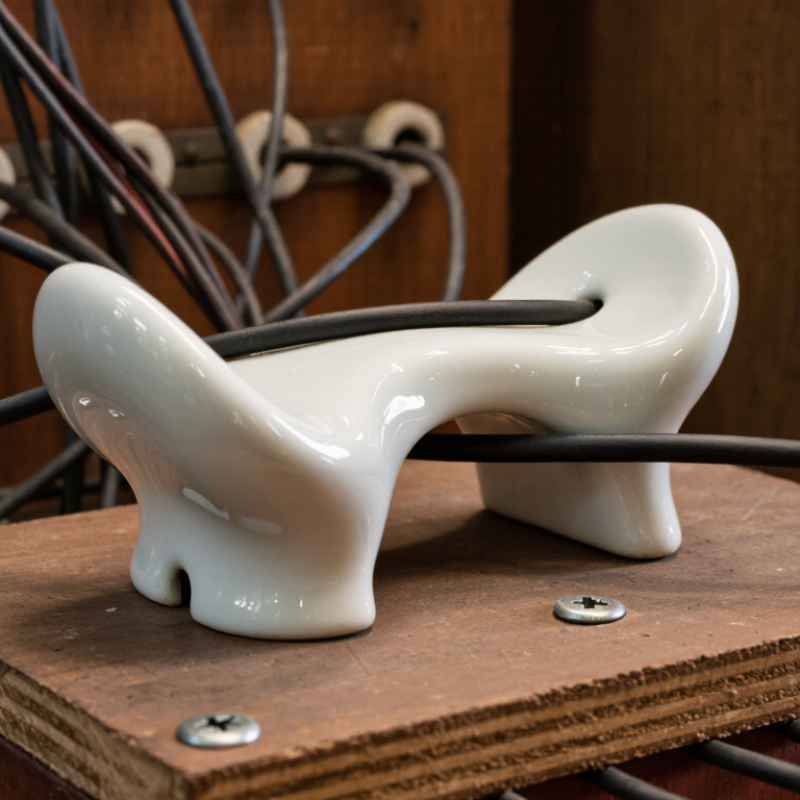
Porcelain Saddles Defined: Ceramic Supports for Conductors and Cables
A porcelain saddle is a ceramic support designed to hold conductors and cables in a stable position. Its curved surface keeps the cable elevated and separated from mounting hardware. This simple shape helps reduce rubbing, sharp bends, and unwanted contact with nearby structures.
Porcelain is valued for its electrical insulation and resistance to heat, sunlight, moisture, and many outdoor conditions. In utility installations, a saddle may support a conductor along a wall, pole, rack, or equipment frame. Metal straps, bolts, or brackets usually secure it. The exact fitting depends on cable weight, tension, spacing, and the installation environment. Small details matter here.
During inspection, technicians look for cracks, chips, loose fasteners, and dark tracking marks on the ceramic. Dirt and salt can collect on the surface, especially near coastlines or industrial areas. Cleaning may help, but damaged porcelain should not be treated as reliable. It needs careful replacement. A saddle can appear sound from a distance while hiding a fine fracture. That is easy to miss. Cable movement, vibration, and poor alignment can also create stress over time. Porcelain saddles are durable supports, but they are not universal solutions. Engineers must still verify clearances, mechanical loads, insulation requirements, and local electrical standards before installation.
Electrical Function: Dielectric Strength Near 5–15 kV/mm and Leakage Control
A porcelain saddle is a shaped ceramic support that holds a conductor while separating it from a metal frame. Its curved surface helps maintain alignment at cable entries, switchgear supports, and compact distribution assemblies. The porcelain body must resist mechanical loading, moisture, and electrical stress during service.
Electrical performance depends heavily on material quality and test conditions. Industry test data for dense electrical porcelain commonly places dielectric strength near 5–15 kV/mm, consistent with ranges reported through ASTM D149 methods. This figure is not a guaranteed field value. Wall thickness, pores, temperature, and electrode shape can change the result. That caveat matters.
A saddle rated at 10 kV/mm may withstand about 10 kV across a 1 mm effective path under controlled testing. Engineers still apply safety margins. IEC 60168 addresses ceramic or glass insulator testing, while IEC 60815-1 guides creepage design under pollution. A clean, dry surface limits leakage current. Dust, salt, condensation, and sharp edges can create conductive paths across porcelain. Field inspections should check glaze damage, hairline cracks, dark tracking marks, and loose hardware. Leakage may rise before visible failure appears. Small surface defects matter. In practice, the best design combines adequate dielectric thickness, longer creepage distance, smooth hardware transitions, and drainage that prevents water films. Surface voltage measurements can support maintenance decisions, but they cannot replace laboratory verification. One overlooked issue is uneven clamping force; excessive pressure may damage porcelain without immediate electrical symptoms.
Voltage Ratings and IEC 60168 Testing for 11–33 kV Porcelain Saddles
What Is a Porcelain Saddle and How Is It Used?
A porcelain saddle supports and positions conductors on medium-voltage distribution structures. Its glazed ceramic body resists weathering, tracking, and surface contamination. In 11–33 kV networks, the selected rating must match system voltage, insulation level, and clearance. IEC 60038 identifies 12, 24, and 36 kV as equipment voltage classes for 11, 22, and 33 kV systems. That difference matters. A 33 kV line does not automatically require a 33 kV equipment rating.
IEC 60168 covers type testing for indoor and outdoor ceramic or glass post insulators above 1 kV. Testing can include dimensional checks, thermal shock, mechanical loading, electrical performance, and visual examination. However, the standard does not provide one universal pass voltage for every porcelain saddle. Designers must review the product construction and declared test category. IEC 60071-1 also links insulation coordination with lightning impulse withstand, switching conditions, altitude, and pollution. CIGRE technical guidance repeatedly treats pollution severity as a practical design variable, not a paperwork detail. Field experience supports that view. Salt, cement dust, and damaged glaze can reduce surface performance.
Tips: Confirm the highest equipment voltage, creepage distance, impulse withstand level, and mechanical load. Check the test report, not only the nameplate. Inspect chips, hairline cracks, and loose fittings before energization. A clean-looking saddle can still hide damage. Site records are often incomplete, so assumptions deserve a second review.
Installation Steps: Clearances, Fasteners, Conductor Position, and Torque
What Is a Porcelain Saddle and How Is It Used?
A porcelain saddle supports and separates an electrical conductor from a mounting surface. Its ceramic body resists heat, moisture, and surface tracking. Installation quality still matters. NFPA’s Electrical Fires report recorded about 26,100 U.S. home structure fires involving electrical distribution and lighting equipment annually from 2015–2019. A properly installed saddle cannot prevent every failure, but it reduces avoidable contact and movement.
Start by checking the required clearance between the conductor, saddle, fastener, and grounded surface. Follow the applicable electrical code and the saddle’s technical instructions. NFPA 70, Article 110.14(D), requires terminal connections to follow the manufacturer’s torque specifications. Do not guess. Mark the mounting holes, drill without cracking the porcelain, and use fasteners suited to the supporting material. Washers can spread pressure, but excessive tightening may damage the ceramic.
Place the conductor fully inside the saddle’s channel. Keep insulation away from sharp edges and avoid pinching. Maintain the specified bend radius, especially near the entry and exit points. The conductor should sit naturally, not twist against the ceramic. Tighten fasteners gradually with a calibrated torque tool. Recheck alignment afterward. I still find this step easy to rush. That is a weakness. Inspect for chips, loose hardware, exposed conductor, and inadequate clearance before energizing. Field records should note the saddle type, measured clearance, fastener size, and applied torque for later verification.
Inspection Criteria: Cracks, Tracking, Pollution, and 50/60 Hz Service Safety
A porcelain saddle is an electrical insulator shaped to support and guide a conductor. It is commonly installed on poles, crossarms, or equipment supports. Its glazed porcelain body separates the energized conductor from grounded structures. The saddle also helps maintain spacing during normal 50 or 60 Hz service. Small hardware details matter. Loose fittings can create movement, noise, and uneven electrical stress.
Inspect the saddle in daylight, using clean binoculars or approved inspection equipment. Look for hairline cracks, chipped edges, and rough glaze. Cracks may widen during temperature changes or vibration. Tracking appears as dark, branching marks caused by repeated leakage currents. Pollution deserves equal attention. Salt, dust, cement residue, and industrial deposits can form a conductive film when wet. A dry insulator may fail its duty after rain. Never touch or clean energized equipment. Qualified personnel must isolate, test, ground, and inspect the circuit according to local procedures. Visual inspection is useful, but it is not perfect; hidden damage can remain inside the porcelain.
Tips: Record the saddle’s location, weather, surface condition, and visible defects. Compare photographs over time. Do not dismiss minor staining without checking leakage paths and nearby clearances. At 50/60 Hz, unusual buzzing, flash marks, or repeated outages require prompt technical assessment. Use approved tools and protective equipment. Even experienced crews can overlook a thin crack.