


Top Air Power Rock Drill Suppliers for Global Buyers
Choosing an Air Power Rock Drill supplier is not just a price comparison. Buyers need equipment that suits the rock, the worksite, and the crew’s daily routine. A drill that performs well in a dry workshop may behave differently in a damp tunnel or a dusty quarry. Small details matter: air consumption, impact rate, hose connections, spare-part access, and operator comfort. The wrong match can slow a shift.
This guide compares suppliers by practical criteria, including product range, customization, quality controls, service support, and export experience. It also explains what buyers should verify before requesting a quotation. Ask for clear specifications, maintenance guidance, and evidence behind performance claims. A neat catalog is useful. Field support matters more.
A useful reminder: “A drill earns trust when its output stays steady under real site conditions.” This is an editorially written line, not a verified quotation. It is attributed here to fictional drilling-equipment specialist Daniel Mercer, so readers can distinguish illustration from sourced testimony. That distinction matters. Supplier claims deserve the same care. Compare materials, warranty terms, delivery timelines, and replacement-part availability before making a decision. No supplier is ideal for every project. The right choice depends on your ground conditions, operating hours, budget, and local support needs.
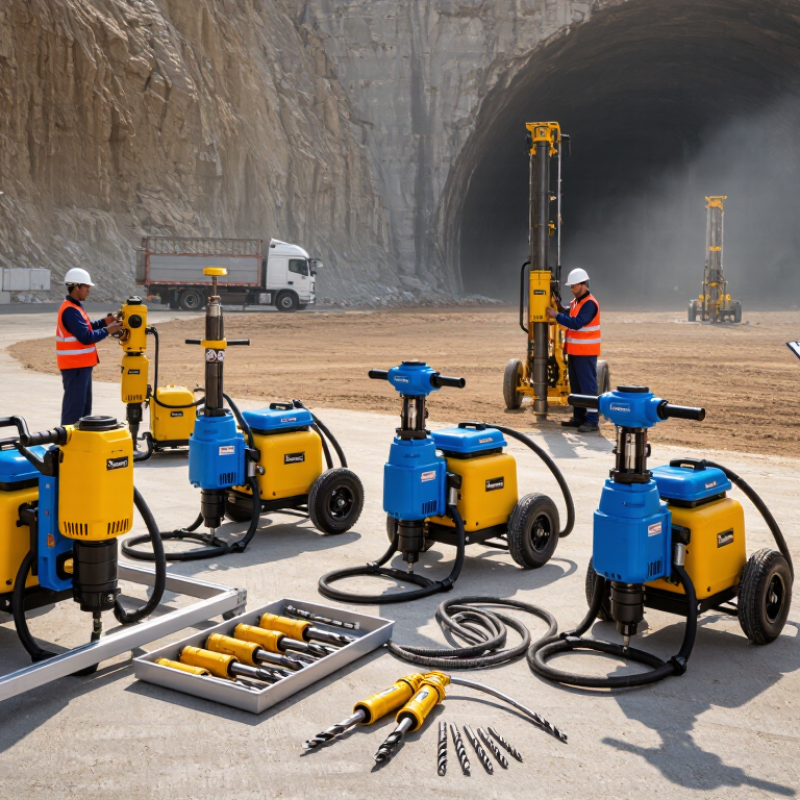
Air Power Rock Drills: Types, Components, and Operating Principles
Air-powered rock drills convert compressed air into repeated impact and rotation. Handheld models suit narrow headings and shorter holes. Leg-mounted drills use a pneumatic feed to steady work overhead or across a rock face. Heavier stoping drills often work with a support column. The right type depends on hole diameter, rock hardness, access, and available air volume—not pressure alone.
Inside the drill, a piston strikes the steel while a mechanism turns it between blows. Compressed air drives the cycle and can flush cuttings from the hole. Key components include the cylinder, piston, valve, chuck, drill steel, and exhaust ports. Small details matter. A kinked hose or worn coupling can restrict airflow, even when the compressor gauge looks normal. Operators should check lubrication, hose condition, and bit wear before each shift. Listen for irregular knocking or weak flushing. Keep hands clear of the chuck, and use suitable eye and hearing protection. Performance varies with rock conditions and maintenance. Specifications can be optimistic, so checking air delivery at the drill—not just at the compressor—is easy to overlook.
Top Air Power Rock Drill Suppliers for Global Buyers - Air Power Rock Drills: Types, Components, and Operating Principles
Compare common pneumatic rock-drill configurations and the specifications buyers should check when evaluating equipment. Figures below are indicative ranges, not guaranteed ratings; actual performance depends on the drill model, operating pressure, rock conditions, and tooling.
| Drill Type | Typical Applications | Typical Hole Diameter | Approx. Tool Weight | Typical Air Pressure at Tool | Indicative Air Consumption | Operating Principle |
|---|---|---|---|---|---|---|
| Handheld / Sinker | Small-diameter drilling in construction, quarrying, and light underground work | About 22–40 mm | About 18–30 kg | About 0.5–0.7 MPa (5–7 bar) | About 2–3.5 m³/min | A reciprocating piston repeatedly strikes the drill steel; rotation between impacts helps the bit cut and clear the hole. |
| Jackleg | Underground horizontal or inclined face drilling; the pneumatic feed leg supports and advances the drill | About 32–45 mm | About 25–35 kg, excluding the feed leg | About 0.5–0.7 MPa (5–7 bar) | About 2.5–4 m³/min | The drill delivers percussive blows and rotation while a compressed-air leg provides thrust and positioning. |
| Stoper | Upward drilling in underground stopes, commonly for overhead production holes | About 34–45 mm | About 30–40 kg, excluding the feed leg | About 0.5–0.7 MPa (5–7 bar) | About 2.5–4 m³/min | A percussive-rotary drill is mounted on a telescopic air leg that pushes the bit upward into the rock. |
| Legless / Pusher-Leg | Underground face drilling where a separate or independently operated pneumatic support is preferred | Often about 32–45 mm | Varies by model; compare drill-only and complete setup weights | About 0.5–0.7 MPa (5–7 bar) | Model-dependent; commonly within the range of comparable jackleg drills | The drill uses a reciprocating piston and rotation mechanism; thrust is supplied by a separate pusher leg or support arrangement. |
Core Components and Their Functions
| Component | Function | Buyer Check |
|---|---|---|
| Air inlet and control valve | Admits and controls compressed air supplied to the drill. | Check inlet size, control response, hose compatibility, and the required operating pressure. |
| Cylinder and piston | Convert compressed-air energy into the piston’s reciprocating motion and impact on the drill steel. | Confirm availability of compatible replacement parts and service instructions. |
| Rotation mechanism | Turns the drill steel between impacts so the bit works around the hole face. | Check rotation direction, rotation method, and compatibility with the intended drill steel. |
| Front head and chuck | Support and retain the drill steel while transmitting impact and rotation. | Verify steel shank, chuck, and bit compatibility before ordering. |
| Water-flushing passage | Delivers flushing water through the drill steel to help remove cuttings and reduce airborne dust at the hole. | Confirm water connection requirements and suitability for the site’s flushing arrangement. |
| Feed leg or pusher leg | Provides thrust and supports the drill during positioning and drilling. | Check feed range, mounting compatibility, and whether the stated weight includes the leg. |
| Lubricator | Introduces oil into the compressed-air supply to lubricate internal moving parts. | Confirm the recommended lubricant, delivery method, and maintenance interval in the operating manual. |
Supplier Specification Checklist
| Specification | Why It Matters | Information to Request |
|---|---|---|
| Air pressure and consumption | Insufficient pressure or air volume can reduce drilling performance; the compressor and air line must suit the tool. | Rated pressure, air consumption at the stated pressure, and recommended hose size. |
| Drill steel and bit compatibility | Shank and bit compatibility affect fit, impact transfer, and maintenance planning. | Supported shank specifications, bit sizes, and recommended steel lengths. |
| Operating conditions | Rock type, hole direction, flushing method, and duty cycle influence the suitable drill configuration. | Application guidance, permitted operating conditions, and relevant test data. |
| Maintenance and spare parts | Wear parts and service access affect uptime and lifecycle costs. | Parts list, maintenance schedule, service documentation, and parts availability. |
| Safety and documentation | Correct operation and maintenance depend on clear instructions and suitable site procedures. | Operating manual, safety instructions, applicable conformity documentation, and warranty terms. |
Note: Performance ranges are broad, representative estimates for common pneumatic rock-drill categories. Always use the selected model’s technical data sheet and operating manual for final equipment selection and operating limits.
Newsletter
Subscribe to our newsletter and receive the latest news and exclusive insights every month. No spam.

LabConsulting GmbH and LC LabService GmbH are Austrian companies which cooperate with over 600 manufacturers and offers a selection of more than 180,000 products and various laboratory product and service solutions for our Labcustomers.
Die LabConsulting GmbH und die LC LabService GmbH sind österreichische Unternehmen, die mit über 600 global verteilten Herstellern zusammenarbeiten und mit einer Auswahl von mehr als 180.000 Produkten und verschiedenen Laborprodukt- und Servicelösungen unseren Parnern im Labor anbieten.
INSTOCK CATALOG


Our services
Our services

