Explore cutting-edge articles on laboratory products, industry innovations, and research trends with Lab Consulting.
carbon fiber products are often marketed through strength-to-weight claims, yet those numbers alone rarely settle a buying decision. The right choice depends on the part’s load, operating environment, production volume, and required finish. A thin panel for an equipment enclosure faces different demands from a pultruded rod or a bicycle component. Details matter.
Dr. Stephen Tsai, a composites researcher, has contributed extensively to the engineering of composite materials. A buyer-focused paraphrase of his design approach is: “Match the composite structure to the load it must carry.” This is a paraphrase, not a verified verbatim quotation. It captures a practical point: fiber type, orientation, resin system, and manufacturing process all affect performance.
This guide introduces ten carbon fiber products that global buyers commonly evaluate, including sheets, tubes, rods, plates, automotive parts, sporting goods, and custom components. For each category, buyers should look beyond appearance and advertised strength. Ask about layup details, dimensional tolerances, testing methods, batch traceability, and packaging for transit. Compare samples against drawings and stated requirements before committing to a large order. Not every supplier can provide every record, and that gap deserves attention.
A glossy surface can hide a mismatch in stiffness or fit. That is easy to overlook. The overview is a starting point, not a substitute for application-specific engineering review. Carbon fiber can be an excellent solution, but it is not automatically the best one. A careful comparison may take longer; sometimes, buyers still discover requirements they missed.
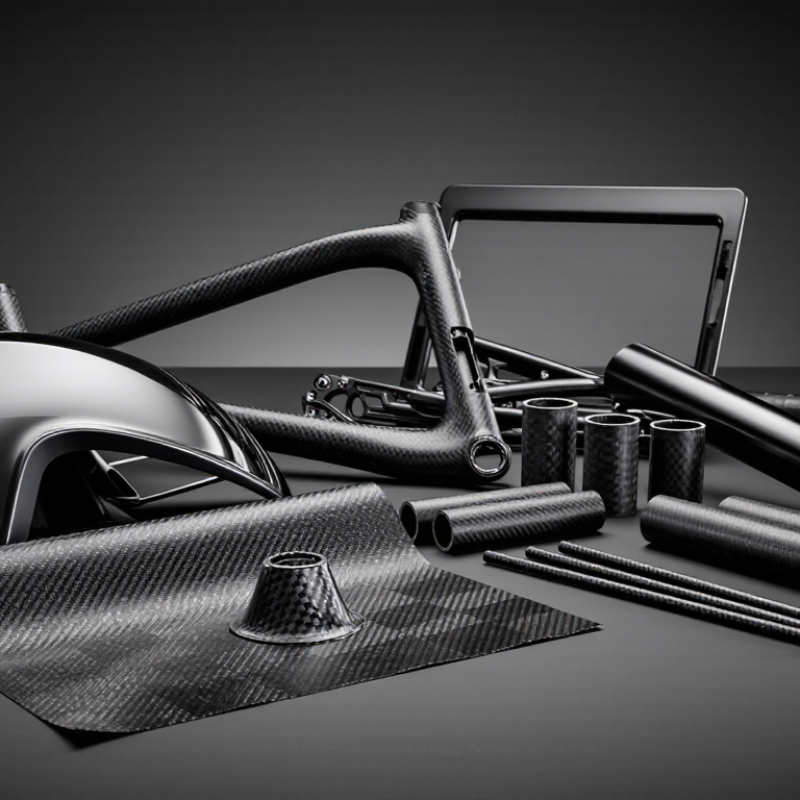
Carbon fiber’s density is about 1.8 g/cm³, compared with roughly 7.85 g/cm³ for steel. ASM Handbook, Volume 21: Composites, gives typical carbon-fiber property ranges, while standard engineering materials references report steel near this value. At equal volume, that difference means carbon fiber weighs about 77% less. A 10-liter component would weigh about 18 kilograms in carbon fiber, versus nearly 79 kilograms in steel, before design details are considered.
That comparison helps explain carbon fiber’s use in bicycle frames, luggage shells, vehicle parts, and sporting goods. One detail is easy to miss. A finished carbon-fiber product includes resin, and its density varies with fiber orientation, resin content, and manufacturing method. Its strength also depends on how the layers are arranged. So a lighter part is not automatically a suitable replacement for a steel one. For global buyers, ask suppliers for the finished product’s mass, test method, and load data—not only the raw fiber density. Small differences matter. A thin-walled shell and a solid bar can share a material label but perform very differently. Even experienced buyers may find the comparison less tidy than the headline suggests.
Carbon fiber products begin well before a finished part. For many structural grades, polyacrylonitrile, or PAN, is spun into fine precursor filaments. These are stabilized and carbonized under controlled heat, creating fibers with high stiffness and strength relative to their weight. Processing conditions affect the final properties, so buyers should request grade-specific data rather than rely on broad claims. Small differences matter.
Fibers can be supplied as continuous tow, chopped strands, or woven fabric. Tow is useful for winding and pultrusion, while fabric offers directional reinforcement for laminates. Weave pattern, fiber orientation, and resin compatibility all influence performance. A fabric may look uniform on a roll but still vary in thickness or handling. Check samples.
Further along the supply chain, carbon fiber tubes are made through processes such as filament winding or pultrusion. Moulded composite parts use shaped tooling and carefully controlled layup or molding conditions. Buyers should compare dimensions, surface finish, fiber direction, resin system, and inspection records. Ask how defects are detected, and confirm test methods match the intended use. No single product suits every project; cost, production volume, and repair needs can change the choice. Some specifications are easy to overlook, including cut-edge quality and moisture protection during shipment.
Carbon fiber products span mobility, industrial equipment, and everyday goods. In mobility, common examples include automotive body panels, driveshafts, bicycle frames, and e-bike structural parts. The IEA’s Global EV Outlook 2024 reports nearly 14 million electric cars sold in 2023, about 18% of global car sales. That growth increases interest in lightweight components, but it does not mean every vehicle part benefits from carbon fiber. Cost, impact resistance, and repairability still matter.
Industrial uses include composite pressure-vessel wraps, wind-turbine spar caps, robotic arms, and lightweight tool handles. The Global Wind Energy Council reported 117 GW of new wind capacity in 2023, illustrating the scale of a sector where lighter blade components can help manage structural loads. Two consumer-facing examples are prosthetic limbs and racket shafts, where stiffness and low weight can support practical performance. Details matter.
A useful correction: lighter is not automatically greener. Carbon fiber production is energy-intensive, and damaged parts can be harder to repair or recycle than metal alternatives. Buyers should compare the full product life cycle, not just weight or strength. These ten product types are a practical cross-sector map, not a universal ranking; material choice depends on design, service conditions, and end-of-life options.
Some of the largest offshore wind turbines use blades longer than 100 meters. Their scale places unusual demands on stiffness, fatigue resistance, and weight. Even a modest reduction in blade mass can ease loads on the hub, drivetrain, and tower. That matters.
Carbon fiber is often used selectively, rather than throughout the entire blade. Manufacturers may place it in spar caps, where high stiffness helps limit bending under changing wind loads. Glass fiber remains common in blade structures, so carbon fiber is not a simple replacement. The design depends on load calculations, resin compatibility, and manufacturing controls.
For global buyers, the details deserve close attention. Ask for consistent fiber properties, traceable batch records, and test data relevant to the intended process. A light roll of fabric is easy to ship; a reliable supply across repeated production runs is harder. Storage conditions matter, too, because moisture or handling damage can disrupt processing. Carbon fiber can add cost, and its benefits vary by blade design. I would avoid treating longer blades as proof that every project needs more carbon fiber. Not everywhere. The material choice still needs project-specific evidence.
| Product Category | Typical Applications | Global Demand Drivers | Common Carbon Fiber Forms | Key Buyer Considerations |
|---|---|---|---|---|
| Wind turbine blade reinforcement | Spar caps and other load-bearing blade sections, particularly in large offshore turbines. | Longer blades capture more wind, while carbon fiber can help reduce structural mass and improve stiffness. Blades in the largest designs can exceed 100 m; carbon fiber is generally used in selected structural areas, not necessarily throughout the entire blade. | Unidirectional carbon fiber fabrics, pultruded laminates, and carbon fiber prepreg. | Check fiber and resin compatibility, fatigue performance, process requirements, quality consistency, and suitability for the blade design. |
| Hydrogen and compressed-gas pressure vessels | Type IV hydrogen storage tanks and other composite-overwrapped pressure vessels. | Hydrogen mobility and industrial gas storage require lightweight vessels designed to contain gas at high pressure. | Filament-wound carbon fiber over a polymer liner. | Review applicable pressure-vessel regulations, design pressure, fatigue-cycle requirements, traceability, and qualification documentation. |
| Aerospace structures | Aircraft interior and structural components, control surfaces, and satellite structures. | Weight reduction can improve aircraft efficiency and payload capacity; aerospace programs also value high specific stiffness and strength. | Prepreg, woven fabric, and unidirectional tape used in engineered laminates. | Confirm material specifications, batch traceability, process controls, testing data, and program-specific approval requirements. |
| Automotive components | Body panels, structural parts, drive shafts, and selected performance-vehicle components. | Vehicle lightweighting and performance targets support demand, while material and processing costs influence where carbon fiber is practical. | Prepreg, woven fabrics, chopped-fiber compounds, and continuous-fiber laminates. | Compare production rate, tooling and curing needs, repairability, surface finish, and total part cost. |
| Bicycle and sporting-goods components | Bicycle frames and forks, tennis racquets, fishing rods, and other lightweight equipment. | Buyers seek low mass, stiffness, and the ability to tailor product performance through laminate design. | Unidirectional and woven prepreg; tube and molded composite constructions. | Assess impact resistance, fatigue behavior, layup consistency, finish requirements, and product-specific testing. |
| Marine components | Yacht masts, spars, foils, and selected hull or deck structures. | Weight savings and high stiffness can benefit sailing and performance craft; composite materials also avoid metal corrosion. | Prepreg, woven fabrics, unidirectional reinforcement, and pultruded profiles. | Check moisture protection, UV-resistant surface systems, fatigue performance, joining methods, and repair procedures. |
| Building and infrastructure strengthening | External reinforcement of concrete beams, columns, slabs, and some masonry structures. | Retrofitting can increase structural capacity or support repairs without adding substantial weight or bulk. | Carbon fiber reinforced polymer (CFRP) sheets, fabrics, and laminates bonded with resin. | Verify design guidance and local approvals, substrate condition, adhesive system, installation controls, and fire-protection requirements. |
| Industrial rollers and machine components | Lightweight rollers, shafts, and rotating or moving machine parts. | Lower component mass can reduce inertia in suitable applications, while high stiffness helps control deflection. | Filament-wound or pultruded tubes and custom composite laminates. | Specify dimensions, load and speed conditions, balance, surface finish, bearing interfaces, and operating environment. |
| Drone and unmanned-aircraft structures | Frames, arms, fuselage sections, and wings for unmanned aircraft. | Low mass and structural stiffness can support payload, endurance, and flight-performance objectives. | Woven fabric, prepreg, molded laminates, and composite tubes. | Consider impact tolerance, vibration behavior, antenna or sensor integration, repairability, and manufacturing repeatability. |
| Prosthetic and orthotic components | Prosthetic blades, foot components, and selected orthotic supports. | Lightweight structures with tailored stiffness can support mobility and user-specific performance needs. | Carbon fiber fabric and unidirectional laminates formed with resin systems. | Assess fit and customization needs, fatigue testing, surface comfort, repair options, and applicable medical-device requirements. |
Carbon fiber products can look similar in a catalog but behave differently in production. Check the tow size, such as 1K, 3K, or 12K, and confirm it suits your weave, handling, and part design. A larger tow is not automatically stronger or better. Ask for the tensile grade and its test basis; a fiber datasheet does not guarantee the performance of a finished laminate.
Request recent test reports, not only a certificate with a standard number. Confirm the method, specimen direction, conditioning, and whether results apply to the supplied product. ISO or ASTM references can help, but only when both parties use comparable procedures. Small differences matter. If values look unusually precise, ask how many samples were tested and whether the figures are typical or minimum values.
Lead times should cover sampling, production, inspection, and transport—not just factory processing. Ask what is in stock and what begins only after order confirmation. Get milestone dates in writing, including time for any pre-shipment checks. I would not treat one supplier’s estimate as a promise; capacity and freight can change. Even a neat spreadsheet needs review. Recheck the schedule before committing your own production dates.
Subscribe to our newsletter and receive the latest news and exclusive insights every month. No spam.
LabConsulting GmbH and LC LabService GmbH are Austrian companies which cooperate with over 600 manufacturers and offers a selection of more than 180,000 products and various laboratory product and service solutions for our Labcustomers.
Die LabConsulting GmbH und die LC LabService GmbH sind österreichische Unternehmen, die mit über 600 global verteilten Herstellern zusammenarbeiten und mit einer Auswahl von mehr als 180.000 Produkten und verschiedenen Laborprodukt- und Servicelösungen unseren Parnern im Labor anbieten.
INSTOCK CATALOGOur services
Our services