Explore cutting-edge articles on laboratory products, industry innovations, and research trends with Lab Consulting.
Rock Wool Mineral Wool is an insulation material made by melting natural rock, basalt, or selected industrial by-products. The molten material is spun into fine fibers, creating a dense, wool-like structure. Tiny air spaces slow heat transfer and help absorb sound. It is commonly installed inside external walls, roofs, ceilings, mechanical rooms, and around pipes.
Its importance is closely linked to building energy performance. The United Nations Environment Programme’s 2023 Global Status Report for Buildings and Construction found that buildings consumed about 30% of global final energy in 2022. The report also identified buildings and construction as responsible for approximately 37% of global energy-related emissions. Proper insulation can reduce heating and cooling demand, although results depend on design, climate, and installation quality. The U.S. Department of Energy also identifies insulation as a practical method for improving indoor comfort and reducing energy loss.
Fire safety is another major reason for choosing mineral wool. Many rock wool products are classified as non-combustible under relevant European testing standards, but performance varies by product and system. Always verify the manufacturer’s certification. The material can also improve acoustic comfort, especially around busy roads, plant rooms, and shared apartment walls. A quiet room feels different.
However, Rock Wool Mineral Wool is not magic. Gaps, compression, moisture, or poorly sealed joints can reduce its effectiveness. Industry market studies, including reports from Grand View Research and MarketsandMarkets, show continued demand for mineral wool in energy-efficient construction. Their forecasts differ, reminding readers to examine methods and regional assumptions. This article explains the material, its main uses, practical benefits, and limitations.
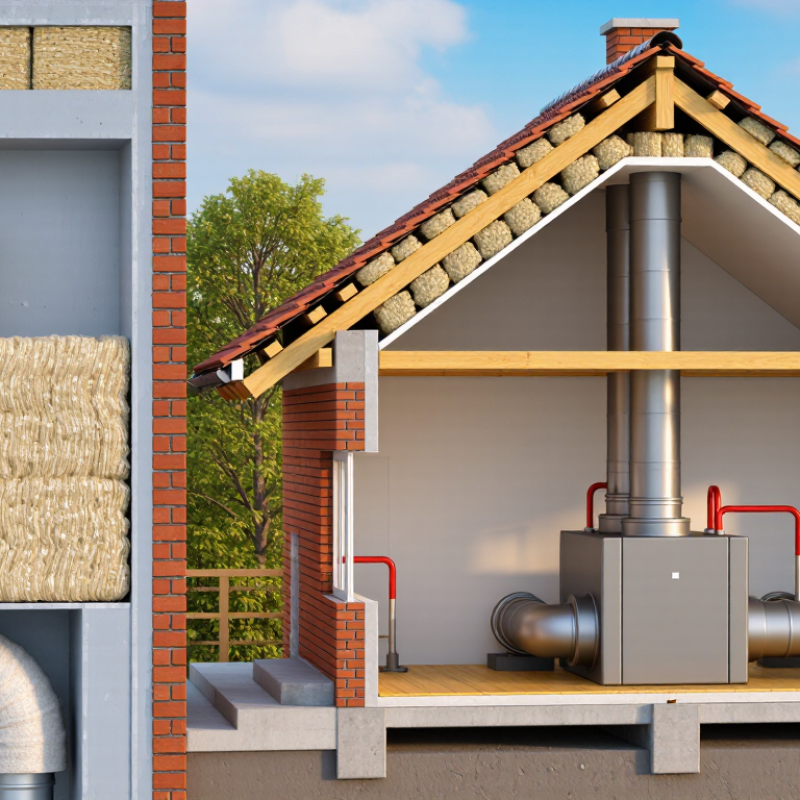
Rock wool, also called mineral wool, begins with basalt, a volcanic rock, and recycled iron-making slag. These raw materials are melted at about 1,500°C in a furnace. The liquid is then spun into thin fibers, resembling grey cotton but behaving very differently. According to technical guidance from the North American Insulation Manufacturers Association, mineral wool commonly provides an R-value near 3.0–3.3 per inch. That value depends on density, installation quality, and moisture conditions.
The fibers trap still air, slowing heat movement through walls, roofs, and industrial equipment. They also resist high temperatures because the mineral base does not easily burn. The U.S. Department of Energy identifies mineral wool as a high-performance insulation option for residential applications. Its sound-control potential is useful around mechanical rooms and busy interior walls. However, “fire resistant” is not the same as fireproof. Performance can change when gaps, compression, or incorrect fasteners appear. Real sites are less perfect than product testing.
Tips: Check the declared thermal resistance, density, facing, and installation method. Wear gloves, long sleeves, eye protection, and respiratory protection while cutting fibers. Review the safety data sheet before work begins. Recycled slag can reduce raw-material demand, but the percentage varies by manufacturer and region. A 1,500°C process also consumes substantial energy, so the environmental trade-off deserves honest assessment rather than simple praise.
What Is Rock Wool Mineral Wool and Its Uses?
How Rock Wool Is Manufactured into Low-Conductivity Insulation
Rock wool starts with basalt, recycled slag, and other mineral materials. Manufacturers melt these ingredients at roughly 1,500°C. High-speed spinning turns the molten mass into fine fibers. A small amount of binder holds the fibers together. The mat then passes through a curing oven, where heat fixes its shape and density.
Its low conductivity comes from structure, not magic. Millions of narrow air pockets interrupt heat movement. The tangled fibers also create a longer path for thermal transfer. The U.S. Department of Energy’s Energy Saver guidance lists mineral wool near R-3.0 to R-3.3 per inch. EN 13162-based technical data commonly reports conductivity near 0.032–0.040 W/m·K. Actual performance depends on density, thickness, moisture, and installation quality. The numbers are useful, but not promises.
Rock wool serves exterior walls, roofs, partitions, and HVAC systems. It also reduces sound transmission and resists high temperatures. However, crushed insulation can lose performance. Gaps matter too. I would inspect joints, corners, and service penetrations instead of trusting the label alone.
Tips: Keep boards dry before installation. Fit edges tightly without compressing them. Check the declared conductivity at the intended temperature. Use project-specific guidance from ASHRAE Handbook data and local building standards. A neat installation often matters more than a slightly better laboratory value.
Rock wool, also called mineral wool, is manufactured by melting mineral raw materials and spinning the melt into fine fibers. Its interlocking fiber structure traps air, reducing heat transfer. Lower thermal conductivity indicates better insulating performance.
Indicative conductivity ranges at approximately 10°C, expressed in W/m·K. Actual values vary with density, moisture, temperature, and product design.
Rock wool, also called mineral wool, is made by spinning melted mineral materials into fine fibers. These fibers trap small pockets of air, slowing heat movement through walls, roofs, and ceilings. Its thermal conductivity is approximately 0.033–0.045 W/m·K. Lower values usually indicate better insulation performance, but the published number is not the whole story.
Density, thickness, moisture, and installation quality can change real results. A compressed batt may lose thickness and perform below its stated rating. Gaps around pipes or poorly fitted joints can create cold paths. Small details matter. During site inspections, tightly fitted boards and sealed edges often make a clearer difference than expected. However, conductivity figures come from controlled tests, not every building condition. This is where specifications need careful reading.
Rock wool is commonly used in external walls, partition systems, lofts, industrial enclosures, and sloped roofs. It can also support acoustic control because its open fiber structure absorbs airborne sound. The material remains dimensionally stable across normal temperature changes and can resist high heat, although the complete assembly must be assessed for fire performance. Moisture deserves attention. Persistent water exposure can reduce thermal efficiency and damage surrounding components. I would not choose insulation from conductivity alone. A slightly lower laboratory value may be less useful than a thicker, correctly installed layer with reliable moisture protection.
What Is Rock Wool Mineral Wool and Its Uses?
Fire, Acoustic, and Moisture Properties Under ASTM C612 Standards
Rock wool, also called mineral wool, is made from spun mineral fibers. It insulates walls, roofs, ceilings, and mechanical rooms. The U.S. Department of Energy lists mineral wool near R-3.0 to R-3.3 per inch. Actual performance depends on density, thickness, installation, and thermal bridging. ASTM C612 classifies mineral fiber boards by physical and thermal requirements. It does not approve every installation automatically.
Fire resistance is a major advantage. Industry technical literature commonly reports fiber melting temperatures above 1,000°C. However, the insulation itself is not a complete fire-rating system. Fire performance must be verified through the full wall or roof assembly. ASTM E84 can assess surface flame and smoke behavior, while ASTM E119 evaluates fire-resistance assemblies. This distinction is often missed.
Acoustically, dense mineral wool can reduce airborne sound and absorb reverberation. The final result depends heavily on cavities, facings, gaps, and framing. A laboratory panel rating cannot predict every occupied room. Under moisture exposure, mineral wool is generally noncombustible and resistant to decay. Still, it is not waterproof. ASTM C612-related product evaluation should be read with water-vapor and moisture-resistance data. Poor flashing or compression can defeat good insulation. That is the uncomfortable part. Field workmanship still matters more than many product tables suggest. (Sources: ASTM C612; ASTM E84; ASTM E119; U.S. Department of Energy Energy Saver guidance.)
What Is Rock Wool Mineral Wool and Its Uses?
Rock wool mineral wool is a fibrous insulation made from melted stone and recycled mineral materials. Its dense structure slows heat transfer and absorbs sound. It also resists fire, although performance depends on thickness, facing, joints, and installation quality. The 2023 UNEP Global Status Report states that buildings consume about 34% of global energy and produce roughly 37% of energy-related process emissions. Better insulation can reduce this pressure.
In walls, rock wool fills stud cavities and limits heat loss around occupied rooms. In roofs, rigid boards help control winter heat flow and summer heat gain. Continuous roof insulation matters, because small gaps can create cold bridges and condensation risks. HVAC systems use mineral wool around ducts, pipes, and equipment to reduce thermal losses and control noise. Industrial facilities apply higher-density products around boilers, tanks, ovens, and hot piping. Product selection should follow temperature limits and relevant standards, such as ASTM C612 or EN 14303. Field inspections often reveal poor compression, open seams, or missing vapor control. The material was specified correctly, but the installation still failed.
Tips: Check the design temperature, moisture exposure, and fire requirements before purchasing. Seal joints carefully. Do not assume thicker insulation fixes every problem; airflow, thermal bridges, and ventilation may deserve equal attention. Energy savings also vary with climate, building use, and workmanship, as noted in U.S. Department of Energy guidance.
| Application Area | Typical Product Form | Primary Function | Relevant Performance Characteristics | Common Installation Locations |
|---|---|---|---|---|
| External Walls | Rigid insulation boards or semi-rigid slabs | Reduce heat transfer and improve fire and acoustic performance | Typical thermal conductivity: approximately 0.034–0.045 W/m·K; non-combustible mineral fibers; water-repellent products are available | Cavity walls, rainscreen façades, external wall insulation systems, and framed wall assemblies |
| Interior Walls and Partitions | Flexible batts, slabs, or acoustic panels | Limit airborne sound transmission and provide thermal insulation | Fibrous structure absorbs sound; performance depends on thickness, density, framing, and the complete wall system | Stud partitions, ceilings, service walls, home theaters, offices, and recording spaces |
| Pitched Roofs and Attics | Batts, rolls, or rigid roof boards | Improve roof thermal resistance and reduce rain and external noise | Suitable thickness is selected according to climate, target U-value, ventilation, and available roof depth | Between rafters, over ceiling joists, and beneath or above roof decking where the system permits |
| Flat Roofs | High-density rigid roof boards | Provide continuous insulation beneath or within a waterproof roof assembly | Good dimensional stability and compressive strength; the board must be compatible with the membrane and roof loading | Warm roofs, protected membrane roofs, commercial buildings, and industrial roof decks |
| HVAC Ductwork | Rigid duct liner, external boards, or wrapped blankets | Control heat gain or loss and attenuate fan and airflow noise | Non-combustible insulation can support fire safety; the vapor-control layer and facing must suit the operating environment | Supply and return air ducts, plant rooms, air-handling units, and mechanical service corridors |
| Pipes and HVAC Equipment | Pipe sections, wired mats, blankets, or removable covers | Maintain fluid temperature and protect personnel from hot or cold surfaces | Product selection depends on service temperature, pipe diameter, moisture exposure, and required thickness | Chilled-water lines, heating pipes, boilers, tanks, valves, pumps, and air-handling equipment |
| Industrial Equipment | High-temperature boards, blankets, wired mats, or molded sections | Reduce heat loss, protect equipment surfaces, and support personnel safety | Useful temperature capability varies by product; high-temperature grades can withstand substantially higher temperatures than building-grade boards | Furnaces, ovens, process vessels, exhaust systems, storage tanks, and industrial ducting |
| Fire Protection Assemblies | Fire-resistant slabs, cavity barriers, firestop components, or pipe penetration systems | Delay the spread of fire, heat, and smoke through building elements | Rock wool is generally non-combustible, but the fire rating belongs to the tested and approved assembly, not the insulation alone | Service penetrations, façades, compartment walls, floors, ceilings, and structural steel protection systems |
| Key Material Properties | Fibers made primarily from natural rock or other mineral raw materials | Combine thermal insulation, sound absorption, and fire resistance in one material family | Density, thickness, facing, binder, moisture conditions, and installation quality strongly affect actual performance | Choose the product according to local building codes, tested system data, exposure conditions, and the manufacturer’s installation requirements |
Note: Performance ranges are general reference values. Exact thermal, acoustic, fire, mechanical, and temperature ratings vary by product specification and the complete installed assembly.
Subscribe to our newsletter and receive the latest news and exclusive insights every month. No spam.
LabConsulting GmbH and LC LabService GmbH are Austrian companies which cooperate with over 600 manufacturers and offers a selection of more than 180,000 products and various laboratory product and service solutions for our Labcustomers.
Die LabConsulting GmbH und die LC LabService GmbH sind österreichische Unternehmen, die mit über 600 global verteilten Herstellern zusammenarbeiten und mit einer Auswahl von mehr als 180.000 Produkten und verschiedenen Laborprodukt- und Servicelösungen unseren Parnern im Labor anbieten.
INSTOCK CATALOGOur services
Our services