Explore cutting-edge articles on laboratory products, industry innovations, and research trends with Lab Consulting.
Choosing a Mag Welding Machine manufacturer in China involves more than comparing amperage ratings and export prices. A machine must deliver stable wire feeding, consistent shielding gas coverage, and repeatable weld quality across actual production shifts. Details matter. For workshops welding carbon steel frames, these differences appear in spatter levels, cleanup time, and unexpected stoppages. This guide examines manufacturers through practical selection criteria, including process capability, documented testing, technical support, and spare parts availability.
Welding metallurgist Sindo Kou explains how heat flow, solidification, and material behavior influence weld quality in his book Welding Metallurgy. His research provides useful technical context for evaluating equipment, although no verified quotation about Chinese manufacturers is available here. One practical buying principle follows: “Judge the machine by the welds it repeatedly produces.” That is this guide’s recommendation, rather than a quotation attributed to Kou. Request a demonstration using your wire diameter, shielding gas mixture, material thickness, and intended welding position. Inspect the results. A polished demonstration on thin plate may reveal little about sustained operation on thicker structural components.
Chinese manufacturers offer equipment for small fabrication shops, automated production lines, and demanding industrial applications. However, broad product ranges do not automatically establish manufacturing consistency or dependable service. Check the evidence. Compare duty cycle ratings under stated test conditions, applicable conformity documentation, and written warranty terms. Even these checks have limits: a successful sample weld cannot establish years of reliability. The strongest shortlist combines measurable performance with transparent documentation and support your team can actually access.
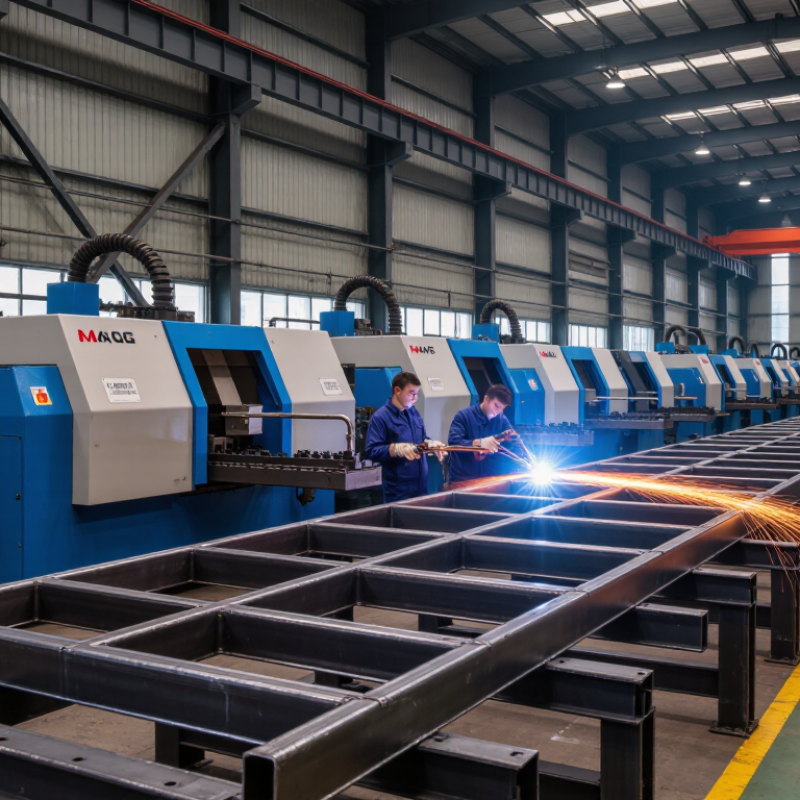
MAG welding uses a continuously fed wire electrode and an active shielding gas, commonly carbon dioxide or an argon-based blend. The gas helps protect the molten weld pool, while the wire supplies filler metal. Operators can adjust voltage, wire-feed speed, and gas flow to suit material thickness and joint design. Small changes matter. A rough, spattering bead may point to poor settings, dirty material, or an unsuitable torch angle, not simply a weak machine.
Machine types vary by power source and feeding arrangement. Compact units combine the power source and wire feeder, making them practical for workshops and routine repairs. Larger systems may use a separate feeder and longer cables for heavier fabrication. Inverter machines are often valued for compact size and adjustable output; synergic models coordinate settings through selected wire and material programs. Pulsed MAG can help control heat input on some applications, but it still requires proper setup and operator skill. Not every feature improves a weld. Inspect the contact tip, liner, and gas nozzle regularly, and test settings on scrap of similar thickness before production. Even then, real joints can behave differently from flat test pieces.
China’s MAG welding machine manufacturing industry supports automotive, shipbuilding, steel fabrication, and general equipment production. Its output ranges from compact workshop units to systems designed for continuous production. Typical machines combine a power source, wire feeder, torch, and controls; stable wire delivery and reliable arc starts matter on the shop floor.
Automation is shaping demand, but robot figures should not be mistaken for welding-machine sales. The International Federation of Robotics reported 276,288 industrial robot installations in China in 2023, equal to 51% of global installations, in World Robotics 2024. This scale creates opportunities for automated welding cells and compatible power sources. It does not prove that every manufacturer offers the same integration or quality. That distinction matters. Buyers should assess rated duty cycle, output stability, feeder performance, and service support using test records, not brochure claims. I would also verify performance with the actual wire, gas, and material; specifications alone can be misleading.
Tips: Request a sample weld on your material and thickness. Check bead consistency, spatter, and restart behavior. Confirm local parts availability and ask how the duty-cycle rating was measured.
Leading MAG welding machine manufacturers in China serve fabrication shops, construction suppliers, and automated production lines. Strong manufacturers provide stable wire feeding, adjustable inductance, and clear voltage controls. These details matter when welding thin sheet or heavier structural sections. Ask for duty-cycle test records, sample welds, and service response times. Brochures are not enough.
Market context helps, but it needs careful reading. MarketsandMarkets valued the global welding equipment market at USD 15.1 billion in 2023 and projected USD 20.2 billion by 2028. This covers welding equipment broadly, not MAG machines alone or Chinese production specifically. For a fair comparison, check how each supplier verifies output stability, handles repeated production runs, and documents component specifications. A low purchase price may conceal costly downtime. That risk is easy to underestimate.
Tips: Test the machine with your actual wire diameter, gas mix, and base metal. Record arc stability and spatter during a continuous run. Request the test conditions in writing, then compare suppliers using the same setup. Look closely. A polished sample weld is useful, but it cannot reveal every weakness in day-to-day service.
Chinese MAG welding machine manufacturers typically offer compact inverter units for repair shops, mid-range synergic systems for fabrication, and high-output power sources for automated cells. Product packages may include wire feeders, water-cooled torches, pulse control, and robotic interfaces. The range matters. A machine rated for thin sheet may struggle with thick plate or long production shifts.
MarketsandMarkets estimated the global welding equipment market at US$15.2 billion in 2023, projecting US$20.5 billion by 2028. This growth reflects demand for more productive, controllable equipment, though it does not guarantee any individual machine’s quality. Buyers should compare output current, rated duty cycle, wire-feed stability, and supported wire diameters. A stable arc at low current helps reduce burn-through on thin steel; pulse modes can improve control on heat-sensitive work.
Technical claims deserve a close look. Manufacturers may specify synergic programs, digital parameter storage, and communication with robotic systems. Ask for test welds using your material, joint design, wire, and shielding gas. Check whether the stated duty cycle applies at the required current and ambient temperature. Catalog data can look tidy; production conditions are not. A little skepticism is useful.
Illustrative operating ranges for common gas metal arc welding transfer modes. Actual ranges depend on wire diameter, shielding gas, material, and setup.
Ranges are approximate process guidance, not manufacturer-specific product specifications.
When comparing Chinese MAG welding machine manufacturers, look beyond catalogue claims. Grand View Research estimated the global welding equipment market at about USD 15.2 billion in 2023 and forecast growth through 2030. This broad market figure signals investment, not product quality. Ask for documented tests on the exact model: continuous-duty performance, wire-feed stability, and weld consistency under repeated starts. A clean sample bead helps. It is not enough. In a factory visit, inspect cable connections, torch consumables, and the clarity of fault codes. Small details often expose weak quality control.
Certification and after-sales support deserve equal weight. Check whether the manufacturer’s quality system is certified to ISO 9001, and whether its welding production processes follow relevant ISO 3834 requirements. Verify certificate scope and validity with the issuing body; a logo on a brochure proves little. Request a written warranty, spare-parts lead times, and response targets for technical support. For example, ask how quickly a common wire feeder or control board can be supplied. Compare those answers in writing. Service promises can sound polished, yet remain vague. I would also request references from comparable users and a trial weld using your material and wire. This process takes time, and test conditions may not fully match your line. Record that limitation before choosing.
A brand-neutral comparison framework for evaluating manufacturers of metal active gas (MAG) welding equipment.
| Comparison Dimension | What to Compare | Relevant Standard or Evidence | Strong Evaluation Signal |
|---|---|---|---|
| Welding performance | Rated output range, available MAG modes, arc stability, and performance under the intended wire, gas, and material conditions. | Model-specific technical datasheet and test results; compare stated ratings with the requirements of the intended application. | Published specifications are consistent across the datasheet, nameplate, user manual, and test documentation. |
| Duty cycle and thermal performance | Rated current, duty cycle, ambient conditions, cooling design, and thermal protection behavior. | IEC 60974-1 covers safety and performance requirements for arc-welding power sources. Check the rating conditions stated for each model. | Duty-cycle figures are clearly tied to a stated current and test condition, rather than presented without context. |
| Wire-feeding system | Wire diameter compatibility, feed-speed range, drive configuration, liner options, and feeding consistency. | Model-specific feeder specifications; IEC 60974-5 applies to wire feeders used for arc welding. | The manufacturer provides compatible wire and torch specifications, setup guidance, and feeder-related test information. |
| Electrical safety | Protection against electrical hazards, enclosure design, connection requirements, and safety instructions. | IEC 60974-1; request a test report or conformity documentation that identifies the exact product model and applicable edition. | Documentation is traceable to the supplied model and includes clear installation, operation, and maintenance instructions. |
| Electromagnetic compatibility | Emissions and immunity performance, installation conditions, and any restrictions for use in particular environments. | IEC 60974-10 covers electromagnetic compatibility requirements for arc-welding equipment. | Model-specific EMC documentation is available, with installation requirements and limitations clearly stated. |
| Quality management | Document control, incoming inspection, production checks, traceability, corrective action, and final inspection. | ISO 9001 applies to quality management systems. ISO 3834 sets quality requirements for fusion welding; its relevance depends on the supplier’s manufacturing scope. | Certificates are valid and issued to the relevant legal entity and site; production and inspection records can be linked to the product. |
| Product conformity | Applicable destination-market requirements, product marking, declarations, and supporting technical files. | For the EU, CE marking indicates conformity with applicable legislation; it is not, by itself, proof of independent third-party certification. CCC applicability should be checked against the current product scope and catalog. | The supplier identifies which rules apply to the exact model and provides matching declarations and supporting evidence. |
| Factory quality controls | Component inspection, calibration, functional testing, output verification, and serial-number traceability. | Request inspection plans, sample production records, calibration records, and final test reports for the proposed model. | Test records are dated, attributable to the production site, and traceable to serial numbers or batches. |
| Customization and engineering | Input-voltage options, control interfaces, feeder or torch compatibility, enclosure requirements, and packaging adaptations. | Written specifications, approved drawings, change-control records, and pre-production sample approval. | Changes are documented and validated; the supplier confirms which certifications or tests may need reassessment. |
| Warranty and technical service | Warranty scope and duration, spare-parts availability, response channels, troubleshooting support, and repair arrangements. | Written warranty terms, service procedure, spare-parts list, and documented support contacts. | Terms define coverage and exclusions clearly, with a practical process for obtaining parts and technical assistance. |
| Delivery and ongoing support | Production lead time, shipment packaging, export documentation, user training, and availability of manuals or updates. | Quotation, confirmed production schedule, packing specification, and documentation list for the destination market. | Commitments are recorded in the order documents, and product documentation is available in the required language. |
Comparison note: This table provides standards-based evaluation criteria, not company-specific ratings or rankings. Verify certificates, test reports, and service commitments against the exact manufacturer, production site, and MAG welding machine model being considered.
Subscribe to our newsletter and receive the latest news and exclusive insights every month. No spam.
LabConsulting GmbH and LC LabService GmbH are Austrian companies which cooperate with over 600 manufacturers and offers a selection of more than 180,000 products and various laboratory product and service solutions for our Labcustomers.
Die LabConsulting GmbH und die LC LabService GmbH sind österreichische Unternehmen, die mit über 600 global verteilten Herstellern zusammenarbeiten und mit einer Auswahl von mehr als 180.000 Produkten und verschiedenen Laborprodukt- und Servicelösungen unseren Parnern im Labor anbieten.
INSTOCK CATALOGOur services
Our services