How to Choose a Ball Bearing CNC Machine in 2026?
Choosing a Ball Bearing Cnc Machine in 2026 requires more than comparing spindle speed and advertised accuracy. Real production exposes weaknesses quickly. A machine may look impressive on a showroom floor, yet struggle with vibration, heat, or inconsistent clamping during long bearing runs. Buyers should examine spindle runout, thermal compensation, axis repeatability, coolant control, and the machine’s performance with hardened or pre-machined steel.
Taiichi Ohno’s manufacturing principle remains useful here: “Without standards, there can be no improvement.” That idea supports a practical evaluation method. Request documented test results, sample parts, inspection records, and maintenance histories. Ask the supplier to machine a bearing race or ring similar to your actual component. Measure roundness, surface finish, cycle time, and dimensional drift after several hours. One polished sample proves very little.
Service quality deserves equal attention. Check spare-parts availability, technician response times, control-system support, and training arrangements. A reliable machine should reduce rejected parts, not merely increase theoretical output. There is no perfect configuration. A faster spindle can create heat, while heavier construction may reduce flexibility. I would also question impressive claims without independent inspection data. That doubt is healthy.
This guide explains how to compare machine architecture, tooling, automation, software, operating costs, and supplier credibility. It also considers future requirements, including smart monitoring and sustainable coolant management. The right choice depends on your tolerances, volumes, materials, operators, and floor conditions. Careful testing remains more valuable than confident marketing.
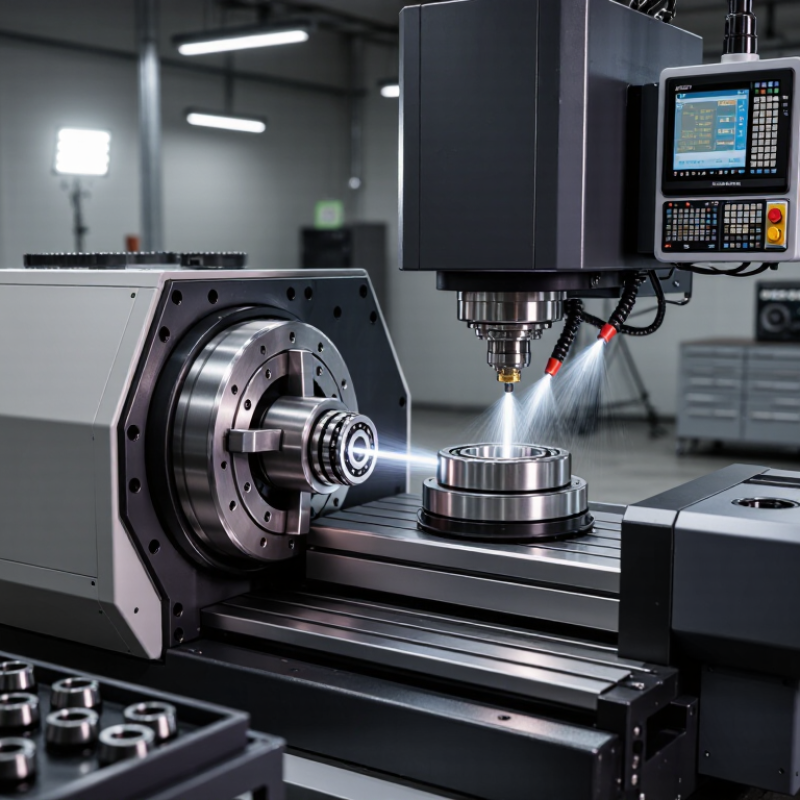
Define the Ball Bearing CNC Machine and Its Main Applications
How to Choose a Ball Bearing CNC Machine in 2026?
A ball bearing CNC machine is a computer-controlled system for producing bearing components. It commonly turns, grinds, drills, and finishes inner rings, outer rings, and cages. Some systems also support inspection and automated loading. The machine follows programmed tool paths, while sensors monitor temperature, vibration, and dimensional changes. In practical production, accuracy matters at the micrometer level. A small raceway error can create noise, heat, or early wear.
Its main applications include electric motors, vehicle transmissions, industrial pumps, robotics, medical equipment, and aerospace assemblies. For example, a motor factory may machine thousands of rings daily, then inspect their roundness and surface finish. A robotics manufacturer may need smaller bearings with extremely smooth movement.
Heavy pumps require stronger components that tolerate continuous loads and contaminated environments. These needs are different. One machine rarely suits every application.
When choosing equipment in 2026, buyers should examine spindle stability, grinding accuracy, software flexibility, and inspection integration. Automatic tool compensation can reduce size variation during long production runs. Energy use and maintenance access also affect real operating costs. I have seen specifications look impressive while chip removal remained weak. That detail is easy to miss. A reliable trial should measure cycle time, noise, surface roughness, and rejected parts using the intended material. Human review still matters, because production data can reveal problems without explaining their cause.
Assess Workpiece Requirements, Bearing Types, and Production Volume
How to Choose a Ball Bearing CNC Machine in 2026?
Begin with the workpiece, not the machine catalogue. Record ring diameter, material hardness, raceway geometry, wall thickness, and required tolerance. A small bearing ring may need high spindle speed and excellent vibration control. Larger rings demand stronger clamping and greater cutting stability. Check coolant access, chip evacuation, and loading space before making a decision. A machine that looks capable may struggle with your actual material.
Bearing type also changes the machining plan. Deep-groove, angular-contact, and tapered designs create different raceway profiles. Confirm whether the machine supports turning, hard machining, grinding preparation, or multiple operations. Ask for measured samples, not only advertised accuracy. I prefer a short trial run using similar steel. It exposes thermal drift, tool wear, and awkward setup time. Perfect specifications can still disappoint.
Tips: Match production volume with automation carefully. For small batches, quick changeovers and simple programming may save more money than a faster spindle. For continuous production, prioritize repeatability, automatic loading, tool monitoring, and accessible maintenance points. Calculate cycle time with inspection and cleaning included. Do not trust optimistic estimates. Recheck them against your operators’ real experience, because manual adjustments often remain invisible on paper. Fresh data matters.
Compare Machine Specifications, Precision, Speed, and Control Systems
How to Choose a Ball Bearing CNC Machine in 2026?
Choosing a ball bearing CNC machine starts with measurable specifications, not impressive brochures. The 2024 World Machine Tool Survey valued global machine-tool consumption at approximately 84 billion dollars in 2023. That scale reflects intense demand for faster, more repeatable production. However, higher speed alone does not guarantee better bearing quality. Compare spindle speed, motor torque, axis travel, acceleration, table load, and thermal compensation. Heat changes everything. For bearing races, a stable spindle and controlled coolant often matter more than maximum revolutions per minute.
Precision figures require careful reading. ISO 230-2 separates positioning accuracy, repeatability, and reversal error. Request each value for the complete working envelope, not only the center position. A machine claiming ±0.005 millimeters may still produce inconsistent parts after several hours. Measure test cuts at startup and after thermal saturation. Check circular interpolation, surface roughness, probe repeatability, and vibration near the target speed. Numbers can mislead.
The control system should provide look-ahead processing, smooth interpolation, tool-wear monitoring, probing cycles, and clear alarm records. Recent manufacturing surveys consistently identify automation and digital monitoring as major investment priorities, but connectivity is not the same as control quality. A practical comparison uses identical bearing steel, tooling, coolant, and cutting conditions. My own selection bias would favor speed too quickly. A slower machine with stronger thermal stability may hold tighter race geometry across a long batch. Also inspect service access, calibration procedures, spare-part availability, and operator training requirements before approving the purchase.
How to Choose a Ball Bearing CNC Machine in 2026?
Compare spindle speed, positioning precision, repeatability, and control resolution before selecting a machine configuration.
These representative 2026 planning benchmarks reflect commonly specified machine-class ranges. Higher spindle speed supports productivity, while lower accuracy and repeatability values indicate better precision. Final selection should be verified against the machine’s official technical datasheet and application requirements.
Evaluate Tooling, Automation, Maintenance, Safety, and Supplier Support
Choosing a ball bearing CNC machine in 2026 requires more than comparing spindle speed. Start with tooling compatibility, runout control, and workholding stability. For bearing races, even small vibration can damage surface finish and roundness. Ask for sample parts, inspection results, and tool-life records. A spreadsheet can still lie.
Automation should match your real production rhythm. Automatic loading, probing, and tool measurement reduce repetitive handling, but complex cells may create new failure points. Deloitte’s 2023 Smart Manufacturing survey found that 86% of manufacturers expect smart manufacturing to become a major competitiveness factor within five years. Select open interfaces, clear alarms, and manual recovery procedures. Do not automate confusion.
Maintenance planning deserves equal attention. The U.S. Department of Energy’s Operations and Maintenance Best Practices guide reports that predictive maintenance can reduce maintenance costs by about 8% to 12% compared with preventive maintenance. Check access to bearings, coolant systems, filters, and servo components. Safety guarding, interlocks, chip control, and ergonomic loading should align with risk-assessment standards such as ISO 12100. Supplier support matters after installation: request response times, spare-parts availability, training hours, and remote diagnostics. I would also test their support before buying. A delayed answer is useful evidence. One weakness remains easy to overlook: operator feedback is often excluded from technical evaluations, although operators notice noise, heat, and awkward access first.
Calculate Total Ownership Costs and Select the Best 2026 Model
How to Choose a Ball Bearing CNC Machine in 2026?
Calculate Total Ownership Costs and Select the Best 2026 Model
Purchase price rarely shows the real cost of a ball bearing CNC machine. Build a five-year ownership sheet before comparing models. Include tooling, fixtures, electricity, coolant, software, operator training, calibration, repairs, and production downtime. Measure twice.
Ask for spindle runout data, positioning accuracy, repeatability, and test-cut results. These figures matter when machining bearing rings or small rolling elements. A rigid frame can protect accuracy during long production runs. However, excessive rigidity may increase the initial price without improving your actual parts.
Calculate energy cost from rated power, daily operating hours, and local electricity rates. Add expected tool replacement and preventive maintenance intervals. Request written service response times and spare-part availability. Downtime hurts. One lost shift can cost more than several months of energy savings.
Compare the machine’s useful capacity with your largest planned component, not an ideal sample. Check workholding space, automatic tool capacity, chip removal, and measurement integration. A compact model may reduce floor space, yet its limited travel could force extra setups. My early estimates often ignored setup time, and that mistake distorted the payback period. Leave room for uncertainty, especially when forecasts depend on new operators or unfamiliar materials. A reliable 2026 choice is the model whose total cost remains manageable when production is slower than expected.
How to Choose a Ball Bearing CNC Machine in 2026? – Calculate Total Ownership Costs and Select the Best 2026 Model
Five-year total cost comparison for anonymous CNC machine configurations used for precision ball-bearing component production. Currency: USD.
Calculation basis: Five-year total ownership cost = purchase price + installation and commissioning + initial tooling and training + five years of energy, maintenance, tooling, and coolant costs. Energy estimates use an industrial electricity rate of $0.12/kWh, approximately 4,000 operating hours per year, and an average machine load of 40%–55% of installed power. Output figures assume 2 shifts per day, 250 operating days per year, and approximately 85% effective utilization. Excludes building construction, financing, labor, raw material, taxes, freight, and production scrap. Actual costs should be confirmed through supplier quotations and site-specific operating data.