How to Choose Steel Slotted Shelving for Global Sourcing?
Choosing Steel Slotted shelving for global sourcing requires more than comparing unit prices. The right system must support safe storage, reliable delivery, and consistent performance across different warehouses. Small details matter. Check steel thickness, upright dimensions, shelf capacity, connector strength, coating quality, and adjustment intervals. A shelf that looks strong may bend under repeated loading.
Warehouse logistics expert Edward Frazelle states, “The warehouse is not a storage facility; it is a flow-through facility.” This principle fits Steel Slotted sourcing well. Shelving should make picking easier, not create narrow aisles or unstable access points. Consider carton sizes, pallet movement, worker reach, and future inventory changes before approving a supplier.
Ask manufacturers for tested load ratings, material specifications, inspection records, and clear assembly drawings. Verify whether the stated capacity applies evenly or at each shelf level. Confirm packaging quality, because damaged corners and missing bolts can delay an entire installation. Request production samples when practical. Photos are useful, but they can hide weak welds and thin coatings.
Global sourcing is rarely perfect. Supplier communication may fail. Lead times may shift. Even experienced buyers overlook local floor conditions. Review these risks openly. Compare landed cost, not only the factory quotation. Include freight, duties, replacement parts, installation, and quality inspections. A dependable Steel Slotted partner should explain limitations clearly and offer traceable corrective action. The cheapest shelf is not always the lowest-cost choice. Safety, repeatability, and service usually decide the long-term value.
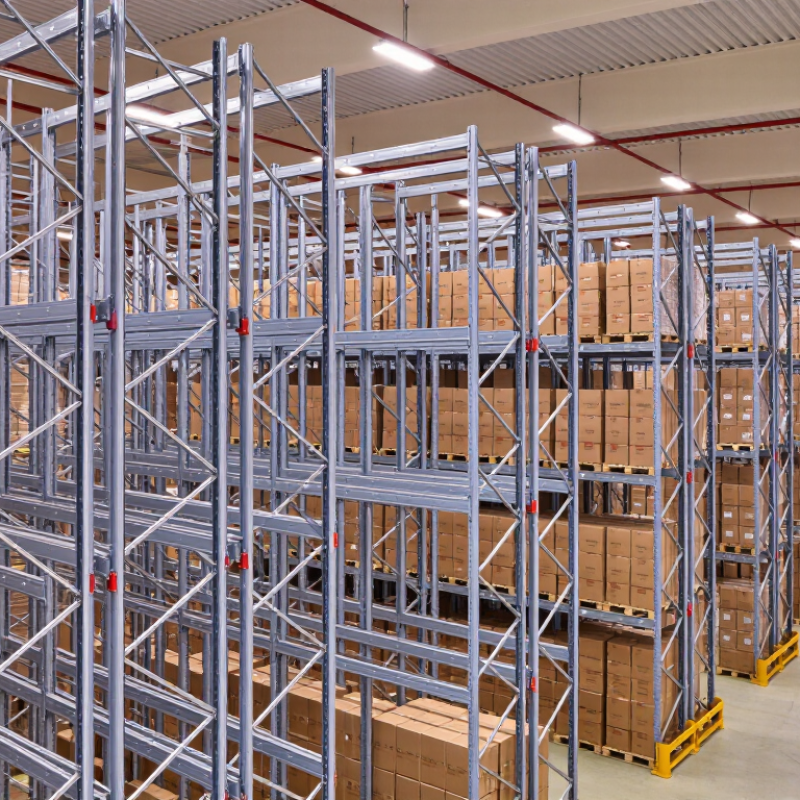
Define Load Capacity Using ANSI MH16.1 Testing and 50–250 kg Shelf Ratings
How to Choose Steel Slotted Shelving for Global Sourcing?
Steel slotted shelving should be selected by tested load capacity, not appearance. A shelf rated at 50 kg serves small cartons, tools, or folded components. Heavier stock may require 100, 150, 200, or 250 kg ratings. Confirm whether the rating applies per shelf, per bay, or the complete unit. Usually, ratings assume evenly distributed loads. One dense box in the center can create a different stress pattern. ANSI MH16.1 testing offers a useful technical reference for structural performance. Ask suppliers for test documentation, loading conditions, deflection limits, and the exact shelf configuration tested. A report for one design may not cover another.
Tips: Check steel thickness, shelf dimensions, upright spacing, and adjustment holes. Request photographs of labels and assembly details. Confirm metric measurements and load markings for every destination market. Keep heavier cartons on lower levels. That improves stability. Do not rely on a rounded catalog number.
A responsible sourcing review also checks floor conditions, corrosion protection, packaging, and replacement parts. A 250 kg shelf may sound impressive, yet it can become unsuitable when the unit is uneven, damaged, or assembled incorrectly. One common mistake is comparing ratings without comparing shelf depth and span. The result can look cheaper, but perform poorly. Details matter. Leave a practical margin below the stated limit, especially where staff frequently rearrange inventory. Recheck the calculation when carton sizes change. That step is often missed.
Compare Steel Grades, Coatings, and ASTM A653 Galvanized-Steel Specifications
How to Choose Steel Slotted Shelving for Global Sourcing?
Steel grade and coating should be evaluated together. ASTM A653/A653M defines commercial steel, forming steel, and structural steel options for galvanized sheet. Structural grades usually suit heavier shelving loads, but the supplier must confirm yield strength, thickness, and slot geometry. A higher grade does not automatically mean a safer rack.
ASTM coating designations also matter. G60 provides about 180 g/m² of zinc coating on both surfaces. G90 provides about 275 g/m², offering stronger protection in humid warehouses. These values are total coating mass, not thickness on one side. Salt air, condensation, and damaged edges can still accelerate corrosion. The 2024 World Steel in Figures report recorded approximately 1.88 billion tonnes of global crude steel production. Supply is extensive, but specifications remain inconsistent across regions. Request mill certificates, coating test results, and load-test evidence. I once focused too heavily on coating weight and overlooked welded-slot damage. That was a costly lesson.
Tips: Match the coating to the environment, not only the purchase price. For dry indoor storage, pre-galvanized sheet may be adequate. For coastal or frequently washed areas, consider heavier zinc protection or an additional finish. Check whether the quoted G90 value follows ASTM A653 testing procedures. Ask for actual base-metal thickness, not only the advertised gauge. Confirm shelf deflection under working load. Small differences become obvious when cartons are fully loaded.
Check Dimensions, Bay Compatibility, and 25–50 mm Adjustable Pitch Options
Choosing steel slotted shelving for global sourcing starts with accurate dimensions, not attractive photographs. Measure the shelf width, depth, upright height, and slot spacing. Allow small manufacturing tolerances. A five-millimeter error can prevent a bay from fitting correctly.
Check bay compatibility before placing a large order. Confirm that shelves, uprights, clips, braces, and panels use matching connection points. Ask for dimensional drawings and a sample assembly when possible. The 25–50 mm adjustable pitch gives useful flexibility for cartons, bins, and changing inventory. Smaller pitch adjustments suit mixed products. Larger intervals can simplify heavy-duty storage.
Load capacity also deserves careful review. Verify the rated load per shelf and per bay under evenly distributed weight. Uneven boxes may reduce real performance. Consider floor level, forklift access, packaging standards, and destination climate. Steel can require suitable surface protection in humid environments. I have seen specifications look complete while omitting shelf deflection limits. That matters.
Do not rely on one supplier’s terminology. “Bay width” may exclude upright thickness in one quotation and include it in another. Request clear definitions, inspection records, material details, and replacement-part availability. A trial order can reveal assembly issues before they affect a full shipment. It costs more initially. It may prevent expensive rework.
How to Choose Steel Slotted Shelving for Global Sourcing? - Check Dimensions, Bay Compatibility, and 25–50 mm Adjustable Pitch Options
| Configuration | Nominal Bay Width | Recommended Shelf Depth | Typical Upright Height | Adjustable Pitch | Common Shelf Levels | Typical Load per Shelf | Bay Compatibility Check | Best-Fit Application |
| Compact single-bay shelving | 600–900 mm | 300–450 mm | 1,800–2,000 mm | 25 mm or 50 mm | 4–6 levels | 80–150 kg, evenly distributed | Suitable for narrow aisles, small cartons, tools, and parts bins | Workshops, maintenance rooms, and compact stockrooms |
| Standard manual-picking bay | 900–1,200 mm | 400–600 mm | 1,800–2,400 mm | 25 mm or 50 mm | 4–7 levels | 120–250 kg, evenly distributed | Confirm shelf beam length, upright slot pattern, and end-frame clearance | General warehouse storage and order picking |
| Wide-bay carton storage | 1,200–1,500 mm | 450–600 mm | 2,000–2,400 mm | 25 mm or 50 mm | 4–6 levels | 150–300 kg, evenly distributed | Use only when the frame and shelf supports are rated for the wider span | Bulky cartons, packaging materials, and light industrial inventory |
| Deep-bay storage | 900–1,200 mm | 600–900 mm | 1,800–2,400 mm | 25 mm or 50 mm | 4–6 levels | 150–300 kg, evenly distributed | Check aisle width, rear access, shelf deflection, and load center depth | Large containers, archive boxes, and deeper packaged goods |
| Multi-bay continuous row | 900–1,200 mm per bay | 400–600 mm | 1,800–2,400 mm | 25 mm or 50 mm | 4–7 levels | 100–250 kg per shelf | Verify shared uprights, row stability, bracing, and compatible add-on bays | High-density stockrooms and long picking runs |
| Low-level access shelving | 600–1,000 mm | 300–500 mm | 900–1,500 mm | 25 mm | 2–4 levels | 80–180 kg, evenly distributed | Allow sufficient hand clearance and confirm base stability without wall fixing | Retail backrooms, offices, and frequently accessed components |
| High-capacity steel shelving | 900–1,200 mm | 450–750 mm | 2,400–3,000 mm | 25 mm or 50 mm | 5–8 levels | 250–500 kg, evenly distributed | Require a documented load rating, frame bracing, anchoring, and installation review | Heavy components and industrial stock storage |
| Mixed-bay modular system | 900–1,200 mm, with different bays in one row | 300–750 mm | 1,800–2,400 mm | 25 mm preferred for fine adjustment | 4–7 levels | 80–300 kg per shelf, by specification | Do not mix upright profiles or shelf connectors unless compatibility is confirmed | Warehouses storing products with varied dimensions |
Selection guide: Choose the shelf depth from the actual carton or container dimensions, leaving practical hand clearance at the front. Select a 25 mm pitch when frequent fine adjustment is required; a 50 mm pitch is generally sufficient for standard carton and bin storage.
Important specification note: Load capacities are typical planning ranges for evenly distributed loads and are not universal ratings. Final capacity depends on steel thickness, shelf reinforcement, upright profile, bay width, bracing, anchoring, installation quality, and applicable local safety requirements. Confirm all dimensions and connector details before combining add-on bays or sourcing replacement components.
Audit Suppliers Through ISO 9001, ISO 2859-1 Sampling, and Factory Inspections
How to Choose Steel Slotted Shelving for Global Sourcing?
Audit suppliers through ISO 9001, ISO 2859-1 sampling, and factory inspections. ISO’s 2023 Survey recorded more than 1.26 million ISO 9001 certificates worldwide. This shows broad adoption, not automatic product quality. Ask for the current certificate scope, audit findings, corrective-action records, and process-control evidence. A certificate covering office procedures may not cover shelving production.
Use ISO 2859-1 to define lot size, inspection level, and AQL before production starts. Inspect critical features, including upright thickness, slot pitch, beam fit, weld appearance, coating coverage, and load-bearing performance. Sampling reduces inspection cost, but it cannot guarantee defect-free goods. Defects may cluster in one carton or production shift. Record sample identities and photographs.
Factory inspection should follow the material flow. Check steel certificates at receiving, verify calibrated measuring tools, and compare approved drawings with actual dimensions. Observe punching, forming, welding, coating, and final packing. The World Bank’s 2023 Logistics Performance Index assessed 139 economies and highlighted reliability, tracking, and shipment timeliness. Packaging deserves equal attention. Bent posts and damaged corners can erase factory quality during transit.
A polished audit room can mislead. Look behind it. Ask operators to explain inspection steps without preparation. Review rejected parts, not only accepted samples. Load tests should use documented fixtures and clear acceptance limits. I would also recheck fastener compatibility after any design change. Small revisions are often where sourcing confidence becomes fragile.
How to Choose Steel Slotted Shelving for Global Sourcing?
Supplier audit reference using ISO 9001, ISO 2859-1 sampling, and factory inspections
The chart shows the ISO 2859-1 General Inspection Level II sample sizes for normal inspection across different shipment lot sizes. Use these sampling levels together with ISO 9001 document reviews and an on-site factory inspection covering materials, dimensions, load capacity, surface treatment, packaging, and traceability.


