

BlogsBlogs

Explore cutting-edge articles on laboratory products, industry innovations, and research trends with Lab Consulting.

Explore cutting-edge articles on laboratory products, industry innovations, and research trends with Lab Consulting.

How to Choose AGV and AMR for Your Warehouse?

Choosing the right warehouse automation system is not a simple technology purchase. Agv Amr solutions can move pallets, cartons, totes, and inventory through demanding environments. Yet their strengths are different. An AGV usually follows defined routes, markers, wires, or mapped paths. An AMR can interpret its surroundings and adjust movement around people, racks, and temporary obstacles.

The best decision begins with the warehouse itself. Measure travel distances, aisle widths, floor conditions, order peaks, and loading points. Observe how workers move during a busy shift. A smooth concrete floor may suit one vehicle, while ramps, uneven surfaces, or narrow aisles may create hidden limits. Safety scanners, emergency stops, traffic rules, and operator training also require careful evaluation. Reliable vendors should explain testing methods, maintenance needs, battery performance, software integration, and service response times.

There is no universal winner.

A fixed AGV route may deliver predictable pallet transport in a stable facility. An AMR may offer greater flexibility when layouts change frequently. However, flexibility can introduce higher software complexity and different integration risks. Costs should include installation, training, downtime, spare parts, and future expansion. A pilot project often reveals problems that specifications hide. It may expose poor Wi-Fi coverage, confusing handoff points, or unrealistic throughput assumptions. These findings are useful, even when they challenge the original plan.

This guide compares Agv Amr capabilities, operating conditions, safety considerations, and long-term value. Practical warehouse evidence should guide the choice, not impressive demonstrations alone.
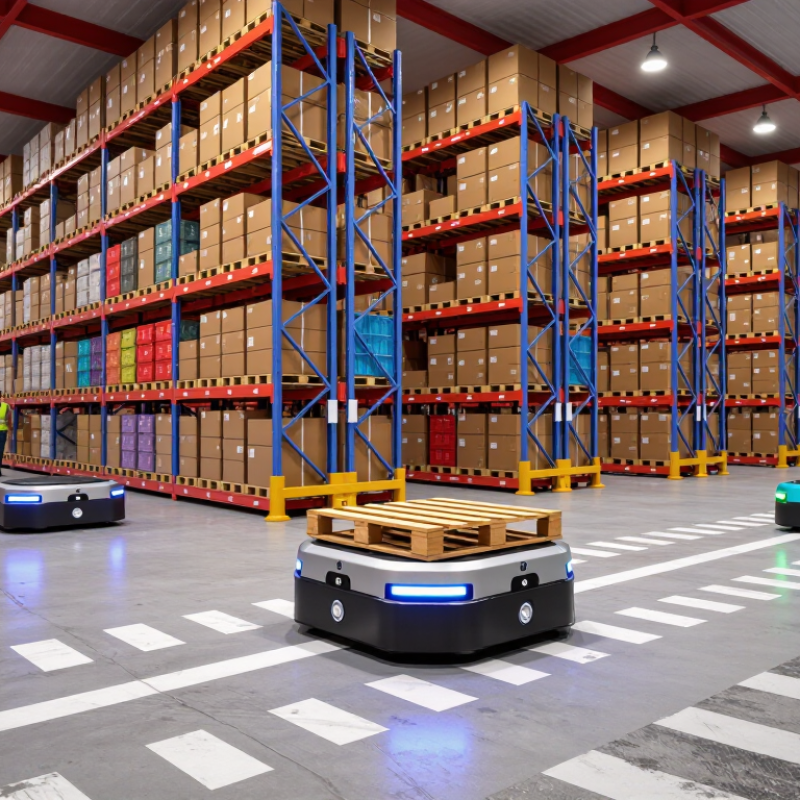
How to Choose AGV and AMR for Your Warehouse?

Define AGV and AMR: Core Technologies and Operating Principles

An AGV, or Automated Guided Vehicle, moves through predefined routes. It may follow magnetic tape, floor wires, reflectors, QR markers, or digital maps. Its controller checks position, speed, load status, and safety sensors. When the route changes, engineers often modify guidance infrastructure or software. This makes AGVs predictable, but less flexible in frequently changing warehouses.

An AMR, or Autonomous Mobile Robot, makes navigation decisions during operation. LiDAR, cameras, encoders, and onboard software help it build or use a warehouse map. It can avoid a parked pallet, recalculate a route, and coordinate tasks through fleet control software. AMRs still need clear safety zones, reliable maps, and disciplined traffic rules. They are not independent of good warehouse design.

The difference matters during selection. A stable, repetitive path may suit an AGV. A mixed-use area with changing storage locations may favor an AMR. The International Federation of Robotics reported nearly 86,000 professional transport and logistics robots sold in 2022. That application grew by about 44% year on year, showing strong operational demand (IFR, World Robotics 2023). However, unit sales do not prove suitability. A short pilot should measure travel time, charging delays, blocked routes, manual interventions, and battery performance. One overlooked aisle can distort the results. Safety validation, worker training, and maintenance access also deserve equal attention.

Assess Warehouse Tasks, Layout, Loads, and Traffic Conditions

How to Choose AGV and AMR for Your Warehouse?

Choosing between an AGV and an AMR starts with warehouse tasks, not equipment brochures. Observe real work during busy and quiet shifts. Record travel distance, pickup frequency, waiting time, and manual touches. The International Federation of Robotics reported 86,000 transportation and logistics robots installed in 2022, a 44% annual increase. That growth shows strong demand, but demand alone does not prove suitability.

AGVs usually perform well on repeatable routes and controlled workflows. AMRs can adjust routes when people, carts, or temporary obstacles appear. Map aisle widths, turning areas, floor conditions, and emergency exits. Measure the full load, including pallets, containers, and unstable items. A 500-kilogram average load may hide occasional 800-kilogram movements. Small details matter.

Traffic needs direct testing. Count crossings near packing stations, lifts, and charging points. Separate pedestrian paths where possible. Use traffic simulations, then validate them with a limited pilot. MHI’s 2024 Annual Industry Report identifies labor pressure and technology investment as continuing supply-chain priorities. Still, automation can create congestion if dispatch rules are weak. I have seen promising layouts fail because charging locations were treated as an afterthought. A perfect model is unlikely. Review near misses, blocked routes, and operator feedback weekly. Choose the system that fits measured work, not the one with the most impressive specification sheet.

How to Choose AGV and AMR for Your Warehouse? — Assess Warehouse Tasks, Layout, Loads, and Traffic Conditions
Assessment Dimension Warehouse Conditions to Check AGV: Typically a Better Fit When… AMR: Typically a Better Fit When… Practical Selection Check
Task type Map each movement: pallet transport, line replenishment, tote delivery, order picking, or returns. Work consists of repeatable, point-to-point moves on established routes, such as moving pallets between a fixed staging area and production line. Tasks involve changing destinations, dynamic dispatch, or navigation around people and temporary obstacles, such as goods-to-person tote delivery. List origin, destination, frequency, and payload for every task. Confirm that the vehicle and attachment are designed for the required operation.
Route stability Consider how often routes, storage locations, workstations, and operating rules change. Routes are stable and can be defined with floor markers, reflectors, wires, or other site-specific guidance infrastructure. Routes change more often, or vehicles need to calculate paths using onboard sensors and a digital map. Estimate route changes per month and identify whether changing a route requires floor work, system reconfiguration, or both.
Layout and aisle space Measure aisle width, turning space, doorways, intersections, ramps, floor condition, and clearance around loads. There is enough room to keep guided routes clear and consistently separated from other traffic. Flexible routing and obstacle avoidance are valuable, provided measured clearances meet the vehicle's turning and safety requirements. Use the manufacturer's loaded turning radius and stopping-distance data. Validate the narrowest aisle and tightest turn on site.
Load and handling Record the maximum and typical load, load dimensions, centre of gravity, transfer height, and pickup method. A standard load and repeatable pickup or drop-off point suit a fixed transport cycle. Different destinations or variable task assignments call for more flexible dispatch, while the payload remains within the vehicle's rated capacity. Compare rated capacity at the required load centre—not just the headline capacity. Include the weight of pallets, containers, or fixtures.
Traffic and people Assess pedestrian crossings, forklifts, doorways, blind corners, peak traffic, and shared work zones. Traffic can be managed with controlled crossings, dedicated lanes, traffic lights, or clearly defined right-of-way rules. Mixed and changing traffic makes onboard detection and dynamic rerouting useful, alongside site-level traffic management. Both types require a documented risk assessment and appropriate safety systems. Do not assume obstacle detection eliminates the need for safe traffic rules.
Throughput and cycle time Measure trips per hour, travel distance, pickup and drop-off time, charging time, and peak demand. Predictable, repeated cycles make it easier to balance vehicle count and route capacity. Workloads and destinations vary, and flexible task allocation can help respond to changing demand. Model the full cycle, including waiting, intersections, handoffs, and charging. Validate the model with a representative pilot.
Integration requirements Check interfaces with warehouse management, warehouse control, production, elevators, automatic doors, and charging systems. A dedicated transport flow and straightforward call points meet operational needs. Tasks need frequent reassignment, fleet coordination, or dynamic interaction with warehouse systems. Confirm available interfaces, data ownership, exception handling, and who will maintain maps and task rules.
Floor and environment Inspect floor joints, slopes, thresholds, dust, lighting, temperature, and areas exposed to moisture. The floor and operating environment support the selected guidance method and reliable repeatable travel. Navigation sensors can operate reliably in the environment, with sufficient visibility and floor conditions for safe movement. Test on the actual floor and at representative operating times. Verify limits for slope, floor gaps, temperature, and environmental protection.
Expansion and change Consider planned layout changes, seasonal volume, additional work areas, and future vehicle types. Expansion is mainly along stable routes with predictable demand. New destinations and changing workflows are expected, and flexible navigation can reduce dependence on fixed routes. Compare the cost and effort of adding vehicles, modifying routes, updating infrastructure, and integrating future workflows.
Decision guide Summarize the dominant operational need rather than selecting by vehicle label alone. Favor an AGV when the workflow is repetitive, routes are stable, and controlled traffic or dedicated paths are practical. Favor an AMR when workflows or routes change frequently and dynamic navigation offers measurable operational value. Capabilities vary by vehicle and installation. Compare validated specifications, safety documentation, site requirements, total operating cost, and pilot results before making a final choice.

Compare AGV and AMR Capabilities for Different Applications

How to Choose AGV and AMR for Your Warehouse?

AGVs suit warehouses with stable layouts, repeated routes, and predictable material flows. They follow magnetic tape, wires, markers, or mapped guidance systems. This controlled movement supports pallet transfer between fixed stations. AGVs can deliver consistent performance during long production cycles. However, route changes may require new infrastructure, software adjustments, or operational downtime. They work best when traffic patterns rarely change.

AMRs use sensors, maps, and onboard software to select routes around obstacles. They can support picking, replenishment, kitting, and short-distance transport. This flexibility helps facilities with changing storage locations or mixed human traffic. An AMR may reroute when a cart blocks its path. That sounds simple. It still needs careful testing. Shelves, reflective surfaces, poor lighting, and crowded aisles can affect navigation. Safety zones and emergency procedures need practical validation.

Compare more than travel speed. Check payload weight, turning space, battery cycles, floor quality, and lift compatibility. Measure stops per hour under real warehouse conditions. Review how each system connects with warehouse software and existing equipment. A common mistake is choosing flexibility without studying maintenance skills or network reliability. Another is selecting fixed routes for a site that changes weekly. Use a small pilot with peak-season tasks, not an ideal demonstration. Record delays, manual interventions, and operator feedback. Those details often reveal the better fit.

Evaluate Safety, Integration, Scalability, and Maintenance Needs

How to Choose AGV and AMR for Your Warehouse?

Choosing between an AGV and an AMR starts with the warehouse environment, not the vehicle catalog. Map pedestrian crossings, narrow aisles, floor damage, loading points, and emergency exits. An AGV suits repeatable routes with fixed guidance. An AMR usually handles changing paths more flexibly. Safety must be tested during peak activity, not only during quiet shifts. Check obstacle detection, speed limits, manual recovery, and safe stopping distances.

Integration often determines the real project cost. Confirm whether the mobile system can exchange tasks with your warehouse software, conveyor controls, scanners, and safety equipment. Use clear data ownership and access rules. A small pilot can expose problems early. For example, a two-second delay in task updates may create queues near packing stations. Do not ignore older equipment. It may become the hardest connection.

Scalability requires more than adding vehicles. Review traffic management, charging capacity, floor space, network coverage, and operator training. Maintenance teams need quick access to batteries, wheels, sensors, and fault records. Spare parts should have defined lead times. Field assessments often reveal overlooked issues, such as dust covering sensors or uneven floors reducing navigation accuracy. We once underestimated charging congestion. That mistake changed the layout. A perfect first design is unlikely. Measure actual travel times, failure recovery, and worker acceptance before expanding.

Build a Cost-Based Selection Framework for Your Warehouse Automation

How to Choose AGV and AMR for Your Warehouse?

Build a Cost-Based Selection Framework for Your Warehouse Automation

Choosing between an AGV and an AMR should begin with operating costs, not purchase price. An AGV often suits repeatable routes, fixed loading points, and predictable traffic. An AMR can handle changing layouts, mixed obstacles, and frequent task changes. In real warehouse assessments, route stability usually affects value more than advertised speed. Measure travel distance, hourly demand, peak periods, and manual handling time before comparing systems.

Build a five-year cost model. Include equipment, software, installation, floor preparation, integration, training, charging, maintenance, and battery replacement. Add the cost of downtime. A small delay at a packing station can spread across the entire shift. Compare cost per completed move, not cost per vehicle. Test different labor rates and volume forecasts. No model is perfect. Our estimates often change after a short site survey, especially when waiting time was underestimated. That uncertainty should remain visible.

Tips: Run a limited pilot in one working zone. Track completed moves, idle minutes, operator interventions, energy use, and safety-related stops. Ask staff where the process fails today. Their practical experience may challenge the spreadsheet. Keep a contingency budget for integration changes. A cheaper system can become expensive when every route needs manual correction. Review results weekly, and document assumptions before approving wider deployment.

Newsletter

Subscribe to our newsletter and receive the latest news and exclusive insights every month. No spam.