Explore cutting-edge articles on laboratory products, industry innovations, and research trends with Lab Consulting.
Choosing an Industrial Power Supply is not just a matter of matching voltage and wattage. The right unit must also handle startup surges, heat, vibration, and continuous operation. A supply that looks adequate on paper may behave differently inside a crowded control cabinet.
For global buyers, the details deserve close attention. Input-voltage range, output stability, efficiency, cooling method, and protection features all affect performance and maintenance. A 24-volt supply serving PLCs and sensors has different demands from one powering motors or production equipment. Check the manufacturer’s datasheet, operating-temperature limits, derating curves, and technical support options before comparing prices. Small details matter.
Certifications also need verification for the destination market and intended application. Product listings can be incomplete, and a familiar label does not replace reviewing current documentation. This guide examines ten industrial power supplies through practical selection factors, including reliability, installation needs, and the availability of clear technical information. No single model suits every facility. Even a well-reviewed unit should be tested under the load and conditions it will actually face. That step is easy to overlook. Our comparisons can narrow the field, but buyers should confirm compatibility with their equipment and consult qualified engineers when system requirements are uncertain.
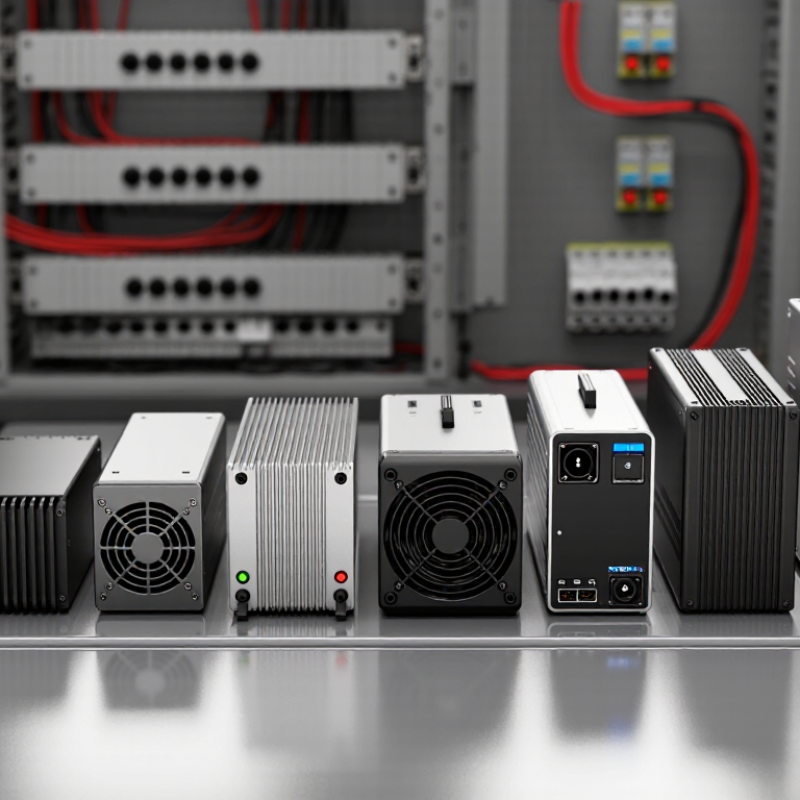
Industrial power supplies convert incoming alternating current into direct current for control panels, sensors, relays, and automation equipment. In many designs, switching circuits adjust voltage, while rectifiers convert AC into pulsating DC. Capacitors smooth it, and regulation keeps output near 24 VDC as loads change. The internal design varies. The goal is steady power, not magic.
A 24 VDC output suits many industrial control devices, but each installation has its own demands. Check input voltage and frequency, output current, ripple, isolation, and operating temperature. Leave headroom for startup surges from solenoid valves or other connected equipment. Small details matter. A cabinet may feel cool outside while the supply runs hot inside. Verify airflow, mounting orientation, and terminal tightness during commissioning; vibration can loosen connections over time. For global projects, check the input range and destination-specific certification requirements rather than assuming “universal input” covers every need. Grounding and transient protection are easy to overlook during replacement work. That deserves a second look. Testing under realistic load can reveal issues that a no-load voltage reading misses. Even experienced teams may find that “24 volts” alone does not describe the whole system.
This illustrative waveform compares nominal 230 V AC, 50 Hz mains input with a regulated 24 V DC output. The AC peak is approximately 325 V (230 × √2); a power supply rectifies and filters the input before regulating it to a stable DC output. Values shown are a conversion example, not measurements from a specific product.
Start with the load, not the catalogue. Record each device’s nominal voltage, operating range, startup behavior, and peak current. A 24-volt control panel may draw modest current normally, yet surge when relays engage. Match output voltage to equipment specifications; do not assume adjustment can compensate for a mismatch. Calculate wattage from simultaneous loads, allowing headroom for expansion and transient demand. Too much headroom is not automatically better. An oversized supply can waste space and complicate thermal design.
Efficiency matters across the real load profile, not just at the headline rating. Check published efficiency curves and measure cabinet temperature during sustained operation. Ripple and noise deserve attention. Sensitive sensors or analog inputs may react to ripple that a motor circuit barely notices. Compare ripple specifications under stated input, load, and bandwidth conditions; figures without test conditions are hard to judge. Apply derating for ambient heat, enclosure airflow, and altitude where relevant. A supply rated for full output in open air may need a lower load inside a crowded, warm cabinet. Leave margin, but verify it against the installation.
| Rank | Representative Configuration | Typical AC Input | DC Output | Rated Power | Typical Efficiency | Ripple Target (mV p-p) | Typical Thermal Derating Guidance | Common Application |
|---|---|---|---|---|---|---|---|---|
| 1 | Compact DIN-rail supply | 100–240 VAC, single-phase | 24 V, 2.5 A | 60 W | About 89% | ≤120 | Often full load to approximately 50°C; reduce load above that point according to the unit’s curve. | Small PLCs, sensors, and control panels |
| 2 | General-purpose DIN-rail supply | 85–264 VAC, single-phase | 24 V, 5 A | 120 W | About 91% | ≤120 | Commonly requires progressive load reduction at elevated ambient temperatures, often above 50°C. | Machine controls and compact automation systems |
| 3 | Mid-range DIN-rail supply | 100–240 VAC, single-phase | 24 V, 10 A | 240 W | About 93% | ≤150 | Check the temperature curve and mounting clearances; enclosure heat can require derating below the published maximum. | Packaging equipment and distributed I/O |
| 4 | High-current DIN-rail supply | 100–240 VAC, single-phase | 24 V, 20 A | 480 W | About 94% | ≤150 | Output capacity may decline at high ambient temperature; verify the manufacturer’s derating curve for cabinet installations. | Robotics, conveyors, and larger control cabinets |
| 5 | Three-phase high-power supply | 3 × 400–500 VAC | 24 V, 40 A | 960 W | About 94% | ≤200 | Thermal limits and airflow are especially important near full load; follow the specified ambient-temperature curve. | Large machinery and centralized 24 V DC distribution |
| 6 | Low-voltage control supply | 85–264 VAC, single-phase | 12 V, 10 A | 120 W | About 90% | ≤120 | Allow for output reduction at elevated ambient temperatures; confirm the permitted operating range for the installation. | Instrumentation, relays, and 12 V control loads |
| 7 | 48 V DIN-rail supply | 100–240 VAC, single-phase | 48 V, 5 A | 240 W | About 92% | ≤200 | Derating is model-specific; check temperature limits and ensure adequate separation from heat-producing equipment. | Telecom peripherals and 48 V industrial devices |
| 8 | High-power 48 V supply | 100–240 VAC, single-phase | 48 V, 10 A | 480 W | About 94% | ≤240 | At high load, use the specified airflow and ambient-temperature derating data; do not assume full output in a sealed cabinet. | Industrial networking and higher-power 48 V loads |
| 9 | High-current 5 V supply | 100–240 VAC, single-phase | 5 V, 20 A | 100 W | About 85% | ≤50 | Confirm output-current limits and cooling requirements; low-voltage, high-current wiring can add significant voltage drop. | Digital electronics, control boards, and test equipment |
| 10 | Redundant-ready 24 V supply | 100–240 VAC, single-phase | 24 V, 20 A | 480 W | About 93% | ≤150 | When used in a redundant arrangement, account for load sharing, module losses, ventilation, and the specified derating curve. | Processes where continuity of control power is important |
Selection note: These are representative engineering benchmarks for common industrial power-supply configurations, not ratings for specific products. Efficiency and ripple depend on operating point and test conditions; ripple figures are indicative peak-to-peak targets and should be compared using consistent measurement bandwidth. Always verify input compatibility, protection features, certifications, output tolerance, and the exact temperature-derating curve in the selected unit’s datasheet.
For global buyers comparing industrial power supplies, harmonic compliance deserves a close look. IEC 61000-3-2:2018 with Amendment 1:2020 applies to equipment drawing no more than 16 A per phase from public low-voltage systems. The standard assesses harmonic currents through the 40th order, with limits depending on equipment class. This matters in a cabinet packed with drives, controllers, and power supplies: distorted current can add heat and complicate system-level testing. A supplier’s “compliant” label is useful, but the test conditions still matter.
A power supply may pass testing alone yet behave differently beside other nonlinear loads. That is not a reason to dismiss the test; it is a reminder to check the actual installation. Ask for the IEC test report, equipment classification, input-voltage range, and operating load used during measurement. The IEC document provides the technical limits; a report tied to the exact model gives buyers evidence they can review. Small details count.
Tips: Confirm whether the declared input current stays within 16 A per phase. Check harmonic results at both typical and maximum load, and verify the report covers the intended voltage and frequency. If several units share one phase, review the complete panel design too. Individual compliance does not automatically guarantee clean aggregate performance. That distinction is easy to miss.
Choosing an industrial power supply means comparing more than rated watts.
Output voltage and current must match the load, including startup surges and changing demand. Check derating curves: a unit rated for 240 watts may deliver less inside a hot, crowded cabinet. Leave headroom. A little extra capacity can reduce thermal stress, though oversized units may waste space and budget.
Form factor shapes installation. DIN-rail models suit control cabinets, enclosed units protect exposed components, and open-frame designs fit equipment with their own housing. Measure the mounting area and airflow before ordering. Protection matters just as much: verify overvoltage, overcurrent, short-circuit, and overtemperature behavior. Ingress ratings also matter where dust or moisture is present. A datasheet can look complete, yet omit the exact fault-recovery behavior your machine needs.
Two reports offer useful context, not product rankings. The IEA’s Electricity 2024 report projected global electricity demand growth averaging 3.4% annually from 2024 to 2026, reinforcing the need to assess efficiency and heat in operating systems. Uptime Institute’s 2024 Annual Outage Analysis found that 54% of surveyed operators said their most recent significant outage cost more than $100,000. That data concerns data centers, not all factories, but shows why protection and serviceability deserve close review. Real cabinet conditions can still disappoint a neat spreadsheet.
For global buyers, the input range is more than a line on a datasheet. Check the permitted AC voltage and frequency against the actual site supply, including expected fluctuations. A unit marked for a wide range may still need derating at high temperatures or under heavy loads. Read the operating curves, not just the headline specification. Small details matter.
Safety certification should match the destination market and the equipment’s intended use. Ask for current certificates and test reports, then confirm that the model number on each document matches the product being quoted. Also review isolation ratings, protective features, and installation clearances. A familiar certification mark is useful, but it does not answer every application-specific question. This step can feel tedious.
After-sales support affects uptime, especially when equipment is installed far from the supplier. Before ordering, ask how technical questions are handled, whether replacement units are available locally, and what information is needed for a warranty claim. Keep a record of serial numbers and installation conditions; those details can speed troubleshooting. Response-time promises deserve scrutiny, too. A written service process is more useful than a vague assurance, though even good documentation cannot prevent every delay.
Subscribe to our newsletter and receive the latest news and exclusive insights every month. No spam.
LabConsulting GmbH and LC LabService GmbH are Austrian companies which cooperate with over 600 manufacturers and offers a selection of more than 180,000 products and various laboratory product and service solutions for our Labcustomers.
Die LabConsulting GmbH und die LC LabService GmbH sind österreichische Unternehmen, die mit über 600 global verteilten Herstellern zusammenarbeiten und mit einer Auswahl von mehr als 180.000 Produkten und verschiedenen Laborprodukt- und Servicelösungen unseren Parnern im Labor anbieten.
INSTOCK CATALOGOur services
Our services